COSMO · The teaching collection

Good questions.
Better conversations.

52 math-circle decks built for thinking together. Start with a problem, compare attempts, and build a reason the whole group can explain. Present with staged reveals and speaker notes, or take the 21-slide PDF into your next circle.

Give the room something to work on.

  1. Try a small case
  2. Compare two routes
  3. Explain why it works
Solutions live in the speaker notes.
Modular Arithmetic teaching deck cover
Number Theory Beginner friendly 21 slides Published September 9, 2025
Number TheoryMathematics

Modular Arithmetic

Remainders, cycles, congruences, and why huge-number questions often need only a small repeating pattern.

View teaching arc
  • Open with the last digit of 7^2026.
  • Build cycles before introducing congruence notation.
  • Explain divisibility tests through place value.
Students work through
  • What is the last digit of 7^2026?
  • Why does the divisibility-by-9 test work?
  • When may remainders replace the original numbers?
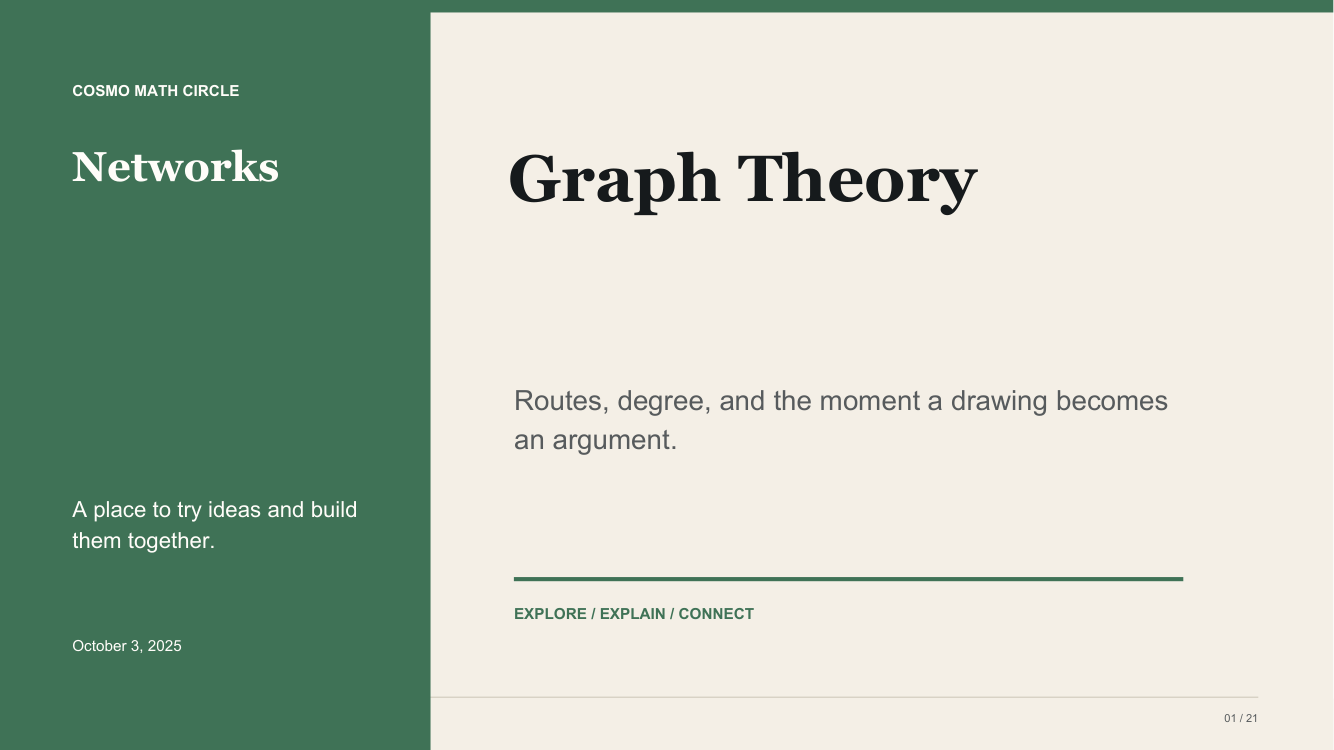
Graph Theory teaching deck cover
Networks Beginner friendly 21 slides Published October 3, 2025
Graph TheoryMathematicsComputer Science

Graph Theory

Vertices, edges, degree, Euler routes, trees, and the local counts that decide global network questions.

View teaching arc
  • Begin with a one-stroke tracing puzzle.
  • Build the odd-degree rule from entry and exit pairs.
  • Use the degree sum as a short proof.
Students work through
  • Can the network be traced in one stroke?
  • Why must odd-degree vertices come in pairs?
  • How does degree turn a drawing into an argument?
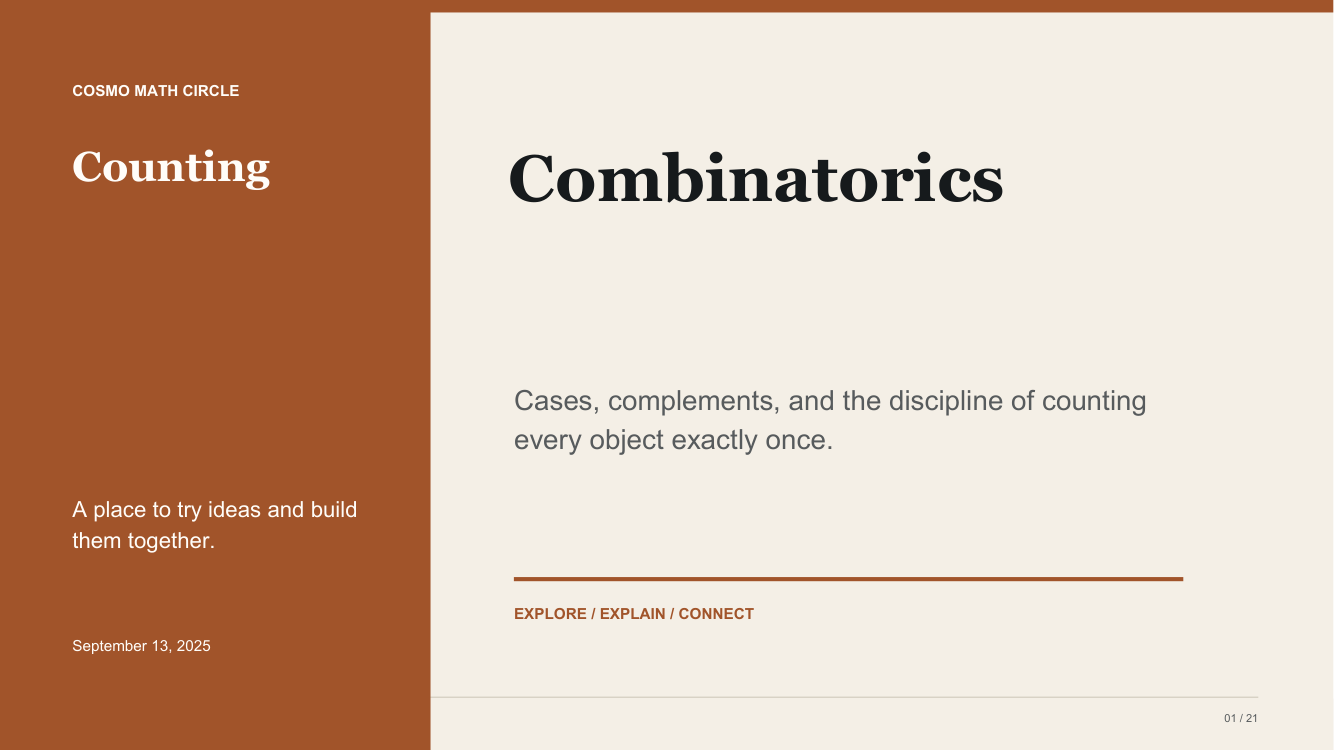
Combinatorics teaching deck cover
Counting AMC / enrichment 21 slides Published September 13, 2025
CountingCombinatoricsMathematics

Combinatorics

Cases, complements, bijections, and the bookkeeping habits that prevent hidden overcounting.

View teaching arc
  • Defend the division by two in the handshake count.
  • Compare direct and complement methods.
  • Use reversible pairings as proof.
Students work through
  • Why are handshakes divided by two?
  • When is a complement easier?
  • What must cases satisfy before their counts can be added?
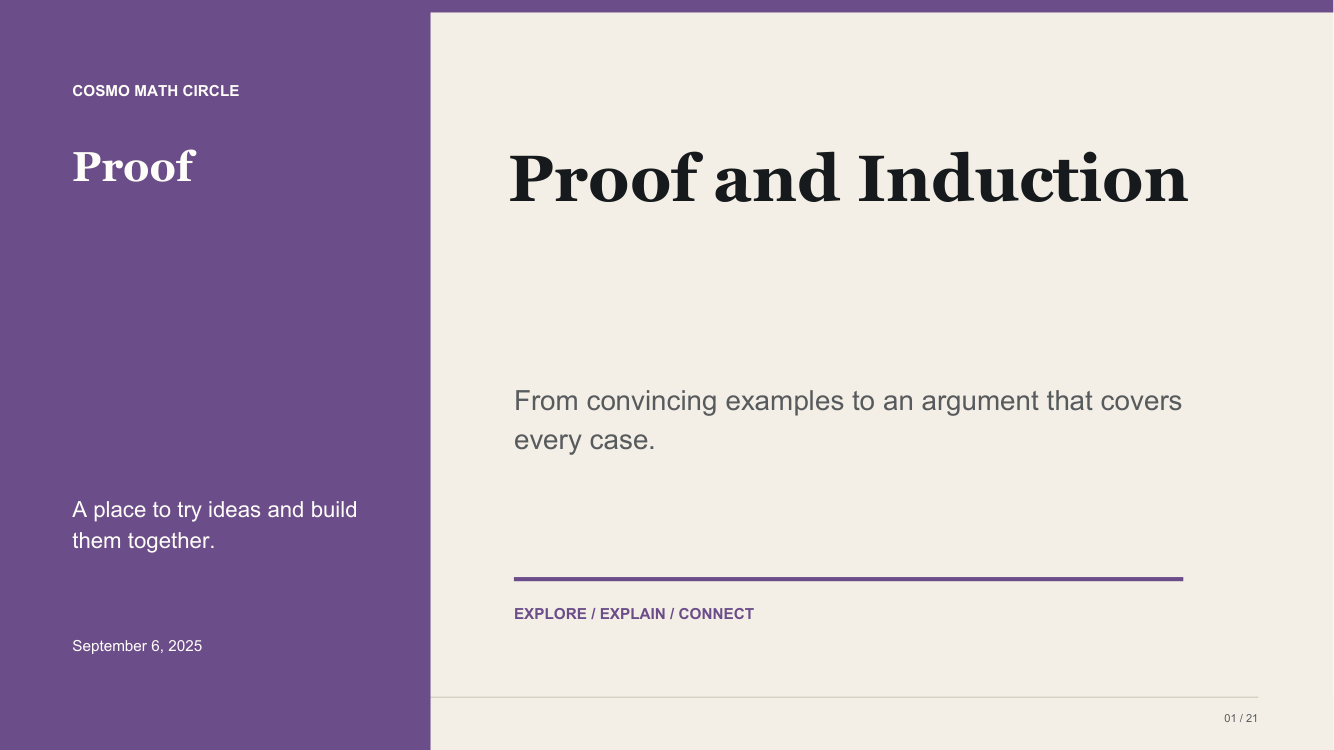
Proof and Induction teaching deck cover
Proof Intermediate 21 slides Published September 6, 2025
ProofMathematics

Proof and Induction

Evidence versus proof, the precise role of an inductive hypothesis, and how a chain reaches every case.

View teaching arc
  • Grow square numbers from odd-number borders.
  • Label BASE, ASSUME, STEP, and CONCLUDE.
  • Repair a proof whose logical link is missing.
Students work through
  • What do examples fail to guarantee?
  • What may the hypothesis be used for?
  • Why does a true step still need a base case?
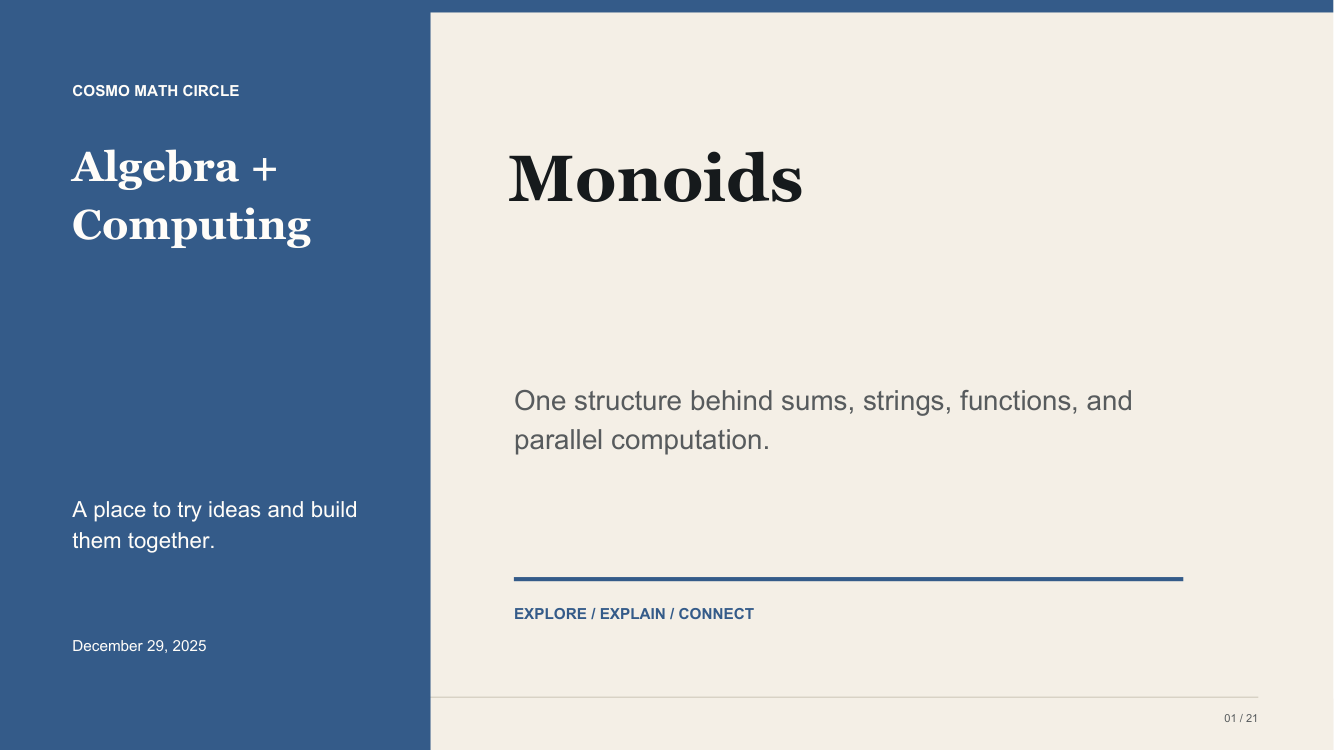
Monoids teaching deck cover
Algebra + Computing Intermediate 21 slides Published December 29, 2025
AlgebraComputer ScienceComputing

Monoids

Closure, associativity, identity, and the structure shared by sums, strings, functions, and data reduction.

View teaching arc
  • Sort examples before naming the structure.
  • Test the set and operation together.
  • Connect associativity to chunked computation.
Students work through
  • What makes an operation safe to repeat?
  • Why must the identity belong to the set?
  • How does associativity enable parallel work?
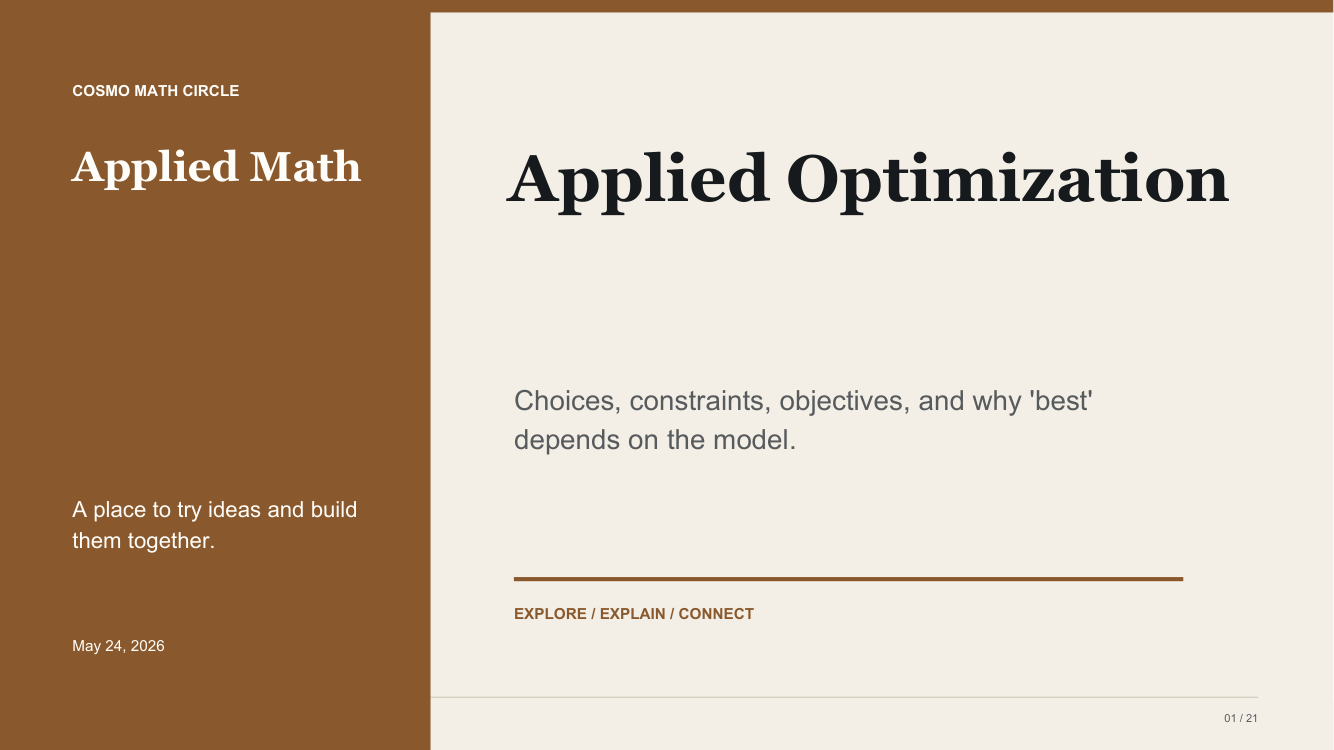
Applied Optimization teaching deck cover
Applied Math Intermediate 21 slides Published May 24, 2026
Applied MathOptimizationMathematics

Applied Optimization

Decision variables, constraints, objectives, feasible choices, and why a locally good move can fail globally.

View teaching arc
  • Ask what 'best' means before calculating.
  • Separate decisions, constraints, and objectives.
  • Disprove a greedy rule with a counterexample.
Students work through
  • What changes when the objective changes?
  • Why can a greedy choice fail?
  • Which model limits are mathematical and which are chosen?
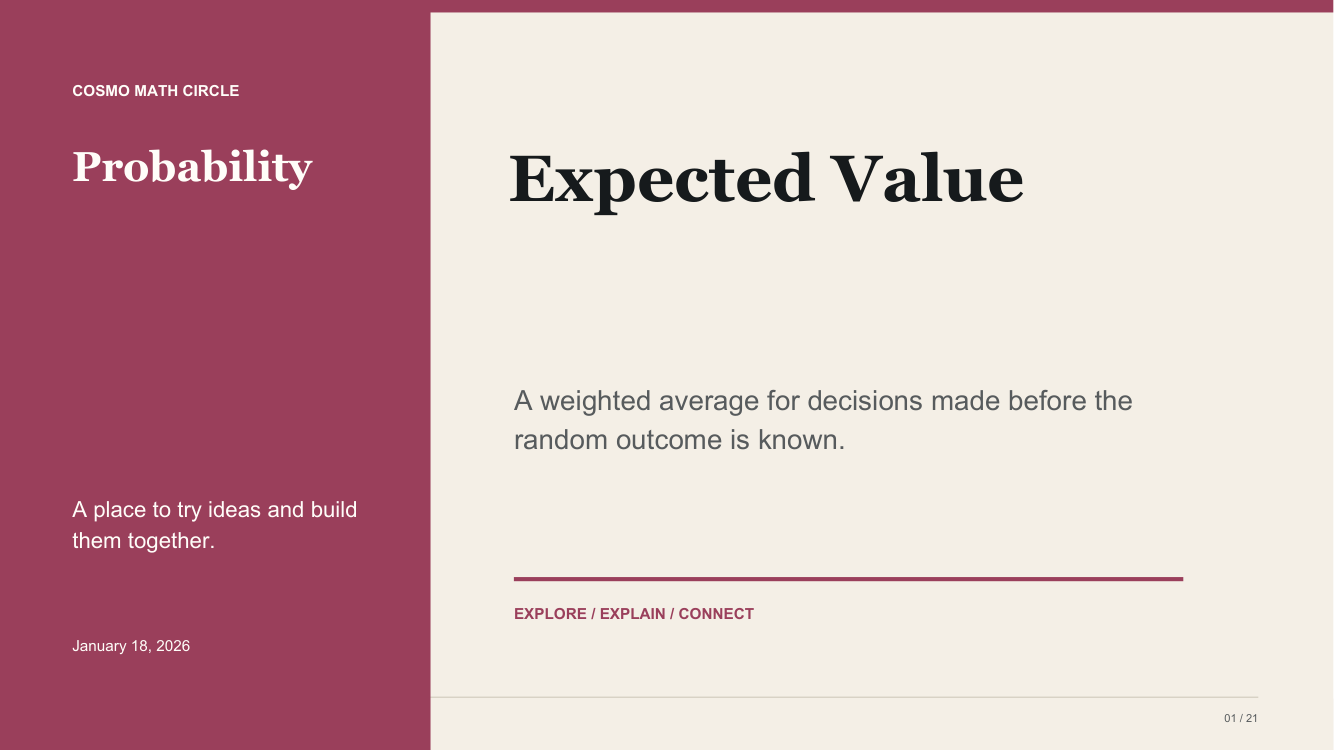
Expected Value teaching deck cover
Probability Beginner to intermediate 21 slides Published January 18, 2026
ProbabilityMathematics

Expected Value

Outcome tables, net payoff, fair games, linearity, and what a long-run average can and cannot predict.

View teaching arc
  • Audit a coin game before defining fairness.
  • Keep probability and payoff in the same table.
  • Separate expected value from the most likely result.
Students work through
  • Where does an entry fee belong?
  • What makes a game fair?
  • Why is expectation not a prediction of the next outcome?
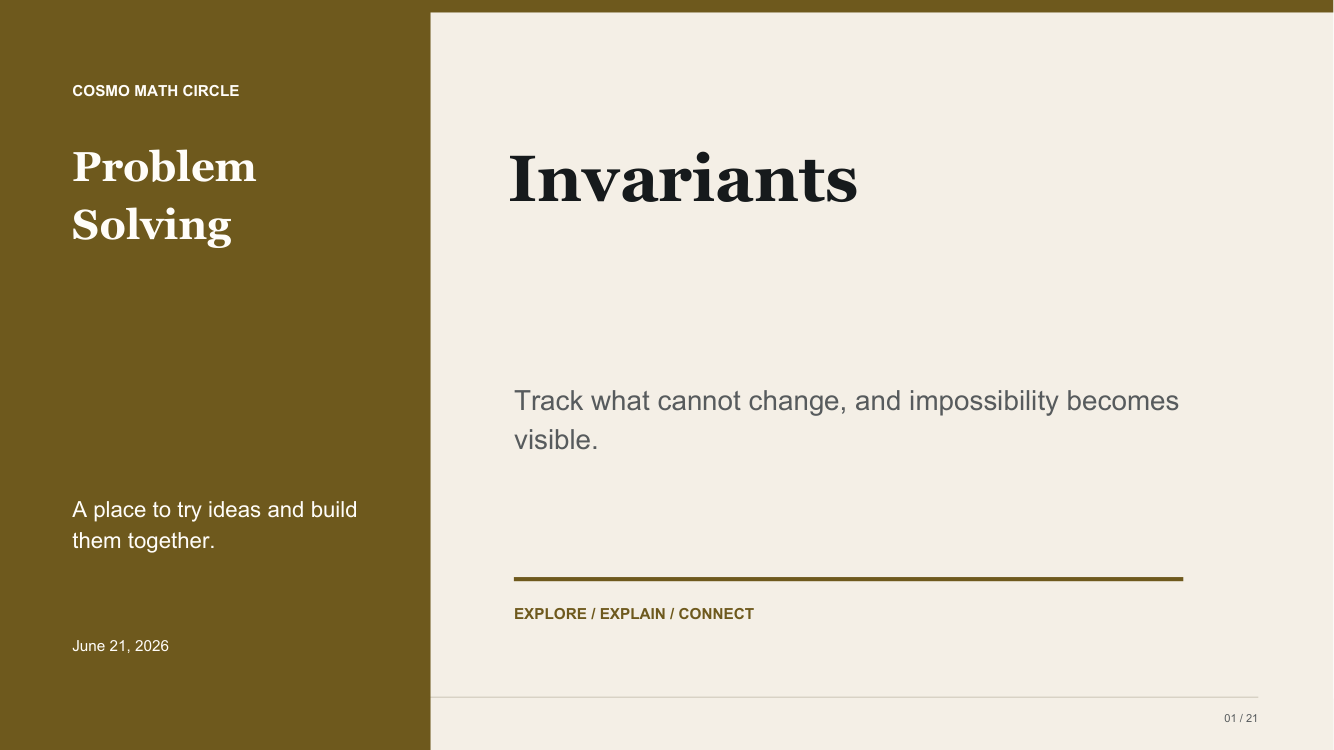
Invariants teaching deck cover
Problem Solving Intermediate 21 slides Published June 21, 2026
Problem SolvingMathematics

Invariants

Parity, coloring, preserved quantities, and the strategy of proving impossibility without tracing every move.

View teaching arc
  • Open with the mutilated chessboard.
  • Track START, MOVE EFFECT, and TARGET.
  • Contrast invariants with decreasing monovariants.
Students work through
  • What must every legal move preserve?
  • Why does coloring prove impossibility?
  • How can a decreasing quantity prove termination?
Euclidean Algorithm teaching deck cover
Number Theory Beginner to intermediate 21 slides Published September 18, 2025
Number TheoryMathematics

Euclidean Algorithm

Replace a large gcd problem with smaller remainder problems without changing the answer.

View teaching arc
  • Try a small case and record every step.
  • Separate what changes from what stays fixed.
  • State the pattern in a sentence before naming the theorem.
Students work through
  • Find gcd(252, 198) without listing every divisor.
  • Use the Euclidean algorithm to find gcd(414, 662).
  • Write gcd(84, 30) as 84a + 30b.
Prime Factorization teaching deck cover
Number Theory Beginner friendly 21 slides Published September 29, 2025
Number TheoryMathematics

Prime Factorization

Break a number into prime building blocks and use exponents to compare divisibility.

View teaching arc
  • Try a small case and record every step.
  • Separate what changes from what stays fixed.
  • State the pattern in a sentence before naming the theorem.
Students work through
  • How many trailing zeros does 25! have?
  • Find the prime factorization of 756.
  • Find gcd(360, 504) from prime exponents.
Linear Diophantine Equations teaching deck cover
Number Theory Intermediate 21 slides Published October 9, 2025
Number TheoryMathematics

Linear Diophantine Equations

Decide when ax + by = c has integer solutions and describe every solution.

View teaching arc
  • Try a small case and record every step.
  • Separate what changes from what stays fixed.
  • State the pattern in a sentence before naming the theorem.
Students work through
  • Can 18x + 30y = 7 have integer solutions?
  • Solve 14x + 21y = 35 in integers.
  • Find nonnegative solutions to 4x + 7y = 39.
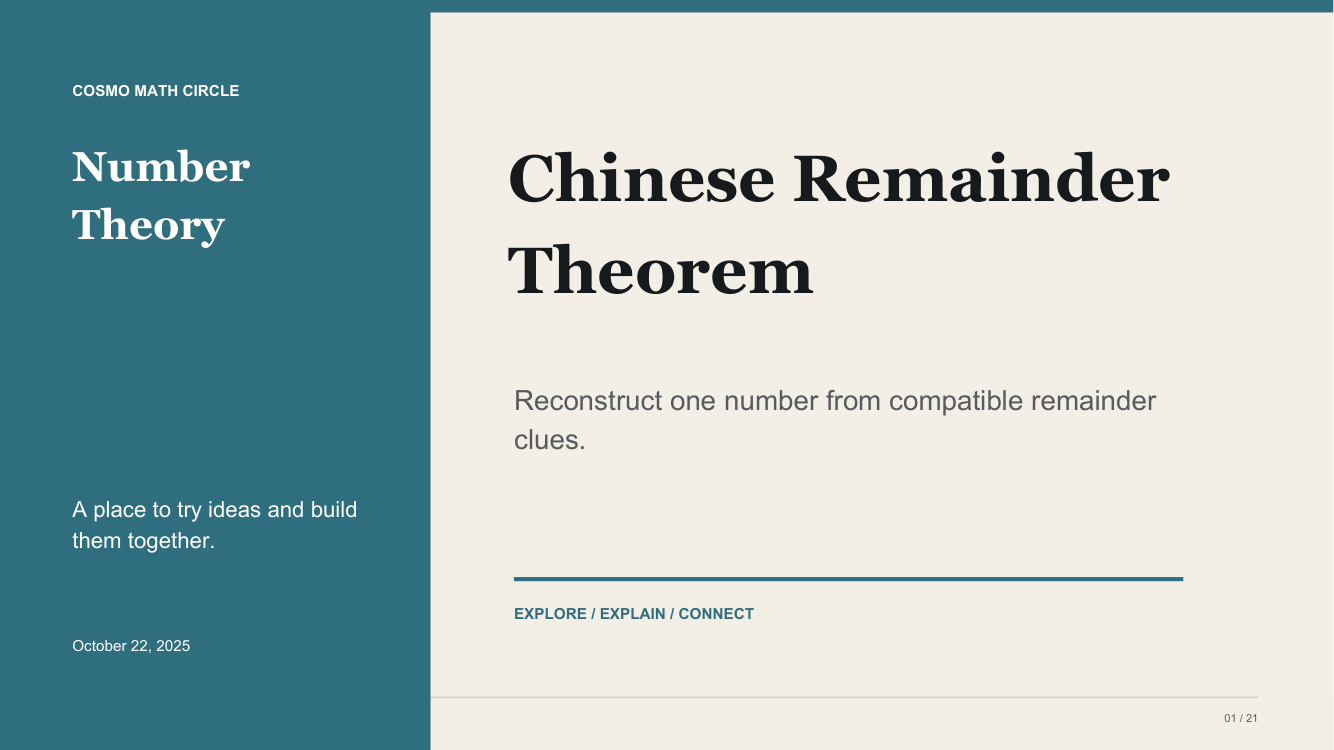
Chinese Remainder Theorem teaching deck cover
Number Theory Intermediate 21 slides Published October 22, 2025
Number TheoryMathematics

Chinese Remainder Theorem

Reconstruct one number from compatible remainder clues.

View teaching arc
  • Try a small case and record every step.
  • Separate what changes from what stays fixed.
  • State the pattern in a sentence before naming the theorem.
Students work through
  • Find the smallest positive n with n = 2 mod 3 and n = 3 mod 5.
  • Solve x = 1 mod 4 and x = 2 mod 5.
  • Solve x = 2 mod 3, x = 3 mod 4, x = 1 mod 5.
Fermat and Euler Theorems teaching deck cover
Number Theory Intermediate 21 slides Published November 5, 2025
Number TheoryMathematics

Fermat and Euler Theorems

Use multiplicative cycles to reduce enormous exponents modulo n.

View teaching arc
  • Try a small case and record every step.
  • Separate what changes from what stays fixed.
  • State the pattern in a sentence before naming the theorem.
Students work through
  • Find 3^100 mod 7.
  • Compute 7^222 mod 10.
  • Compute 2^100 mod 15.
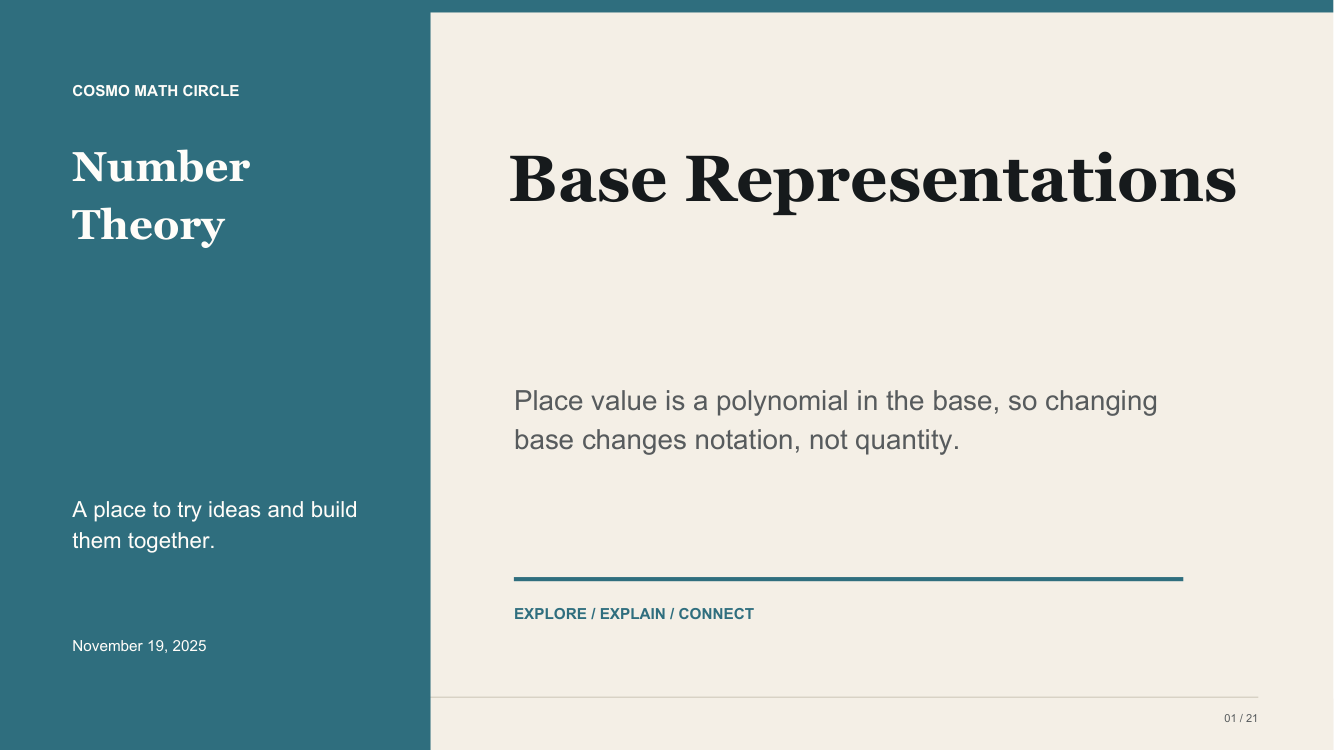
Base Representations teaching deck cover
Number Theory Beginner friendly 21 slides Published November 19, 2025
Number TheoryMathematics

Base Representations

Place value is a polynomial in the base, so changing base changes notation, not quantity.

View teaching arc
  • Try a small case and record every step.
  • Separate what changes from what stays fixed.
  • State the pattern in a sentence before naming the theorem.
Students work through
  • Convert 101101 in base 2 to base 10.
  • Write 83 in base 5.
  • Add 132 base 4 and 23 base 4.
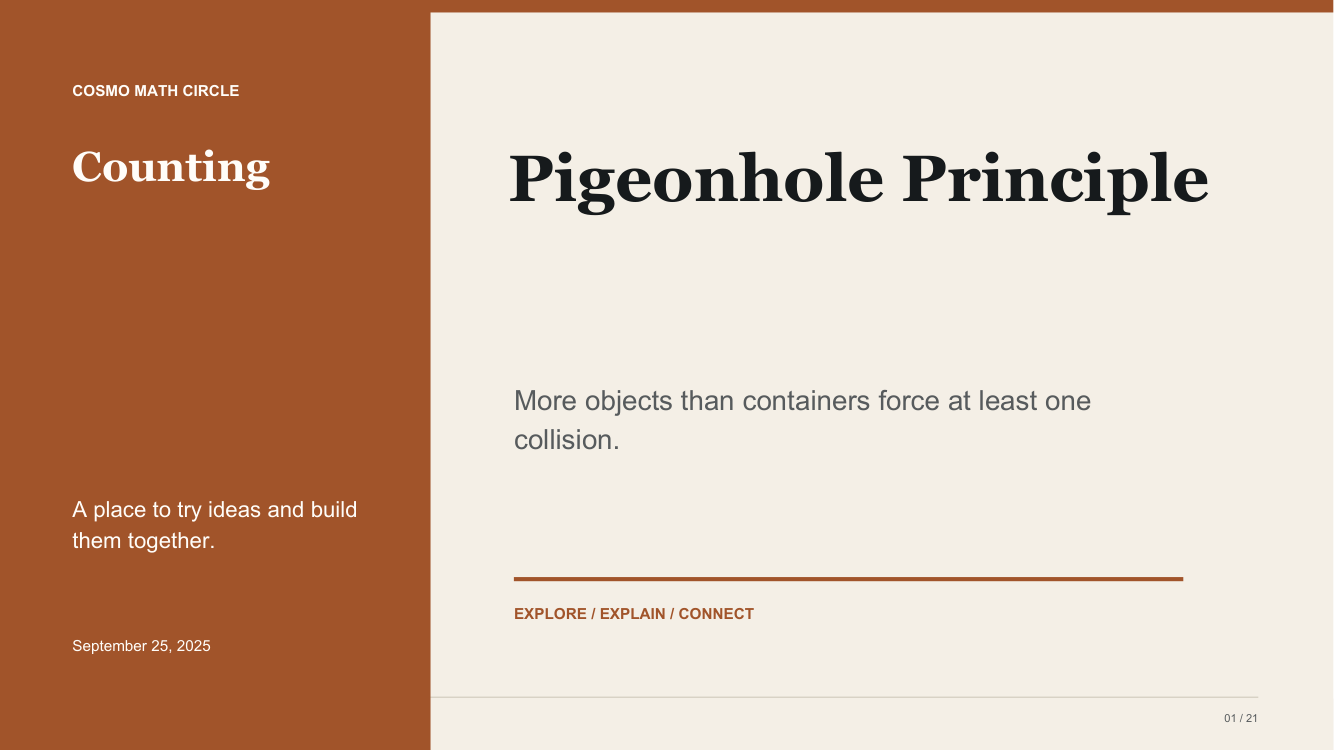
Pigeonhole Principle teaching deck cover
Counting Beginner friendly 21 slides Published September 25, 2025
CountingCombinatoricsMathematics

Pigeonhole Principle

More objects than containers force at least one collision.

View teaching arc
  • Try a small case and record every step.
  • Separate what changes from what stays fixed.
  • State the pattern in a sentence before naming the theorem.
Students work through
  • Why must two of 13 people share a birth month?
  • Show that among six integers, two have the same remainder mod 5.
  • How many students force at least four to share a birth month?
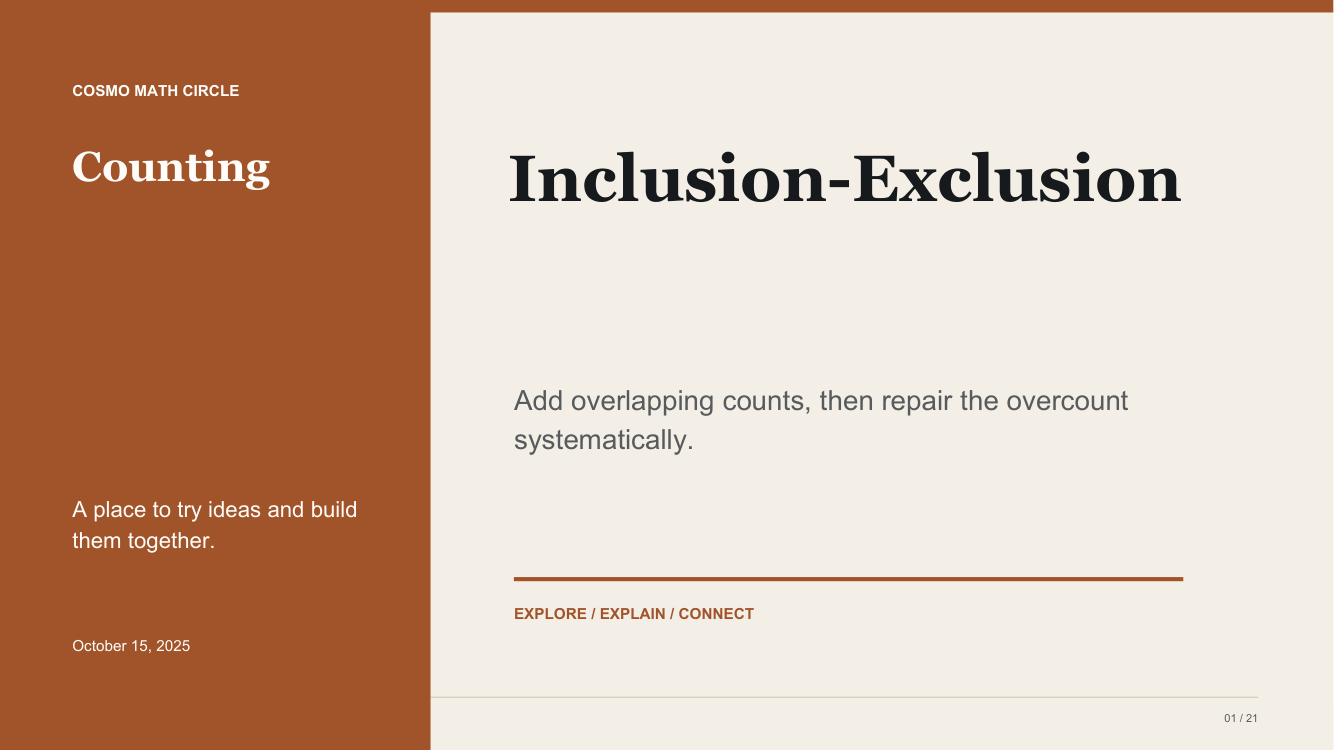
Inclusion-Exclusion teaching deck cover
Counting Intermediate 21 slides Published October 15, 2025
CountingCombinatoricsMathematics

Inclusion-Exclusion

Add overlapping counts, then repair the overcount systematically.

View teaching arc
  • Try a small case and record every step.
  • Separate what changes from what stays fixed.
  • State the pattern in a sentence before naming the theorem.
Students work through
  • How many integers from 1 to 100 are divisible by 2 or 5?
  • Count students taking algebra or geometry when 22 take algebra, 18 geometry, and 7 both.
  • How many integers from 1 to 60 are divisible by 2, 3, or 5?
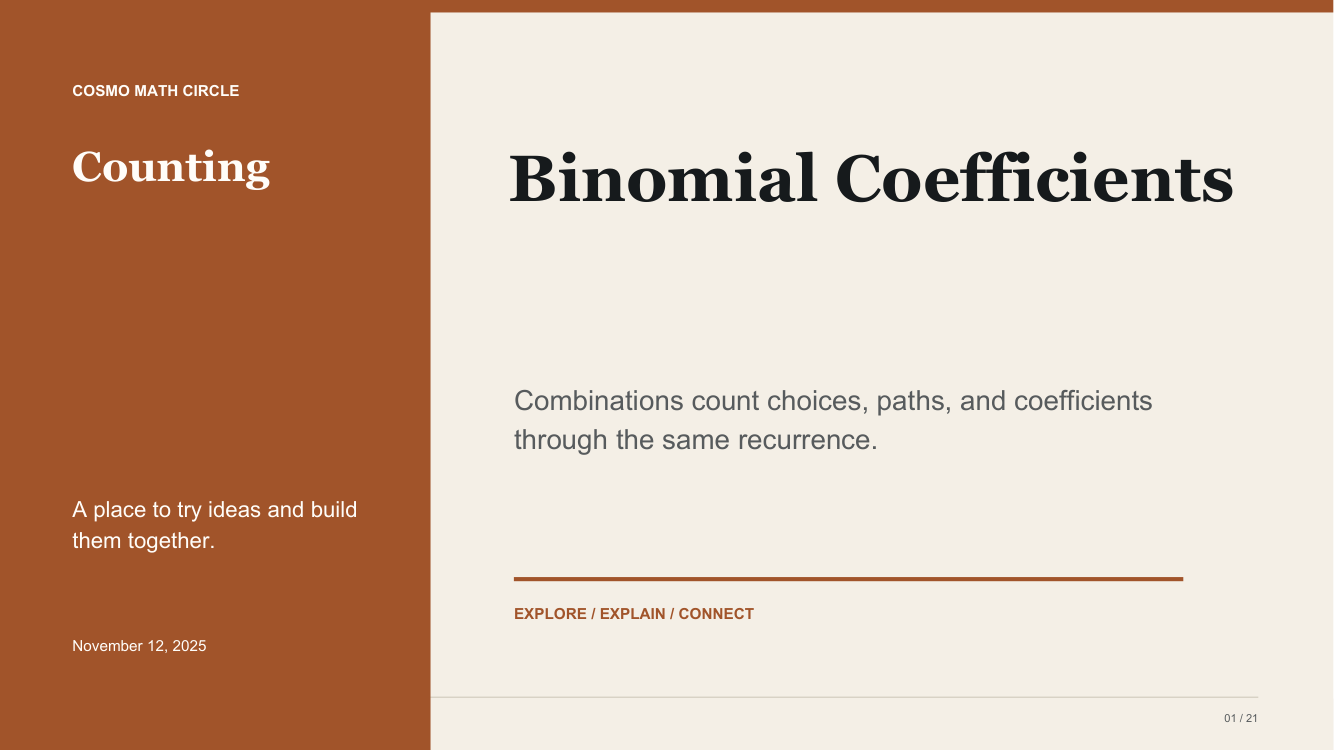
Binomial Coefficients teaching deck cover
Counting Beginner to intermediate 21 slides Published November 12, 2025
CountingCombinatoricsMathematics

Binomial Coefficients

Combinations count choices, paths, and coefficients through the same recurrence.

View teaching arc
  • Try a small case and record every step.
  • Separate what changes from what stays fixed.
  • State the pattern in a sentence before naming the theorem.
Students work through
  • How many five-person committees can be chosen from 12 students?
  • Explain why C(8,3) = C(8,5).
  • Find the coefficient of x^4 in (1 + x)^9.
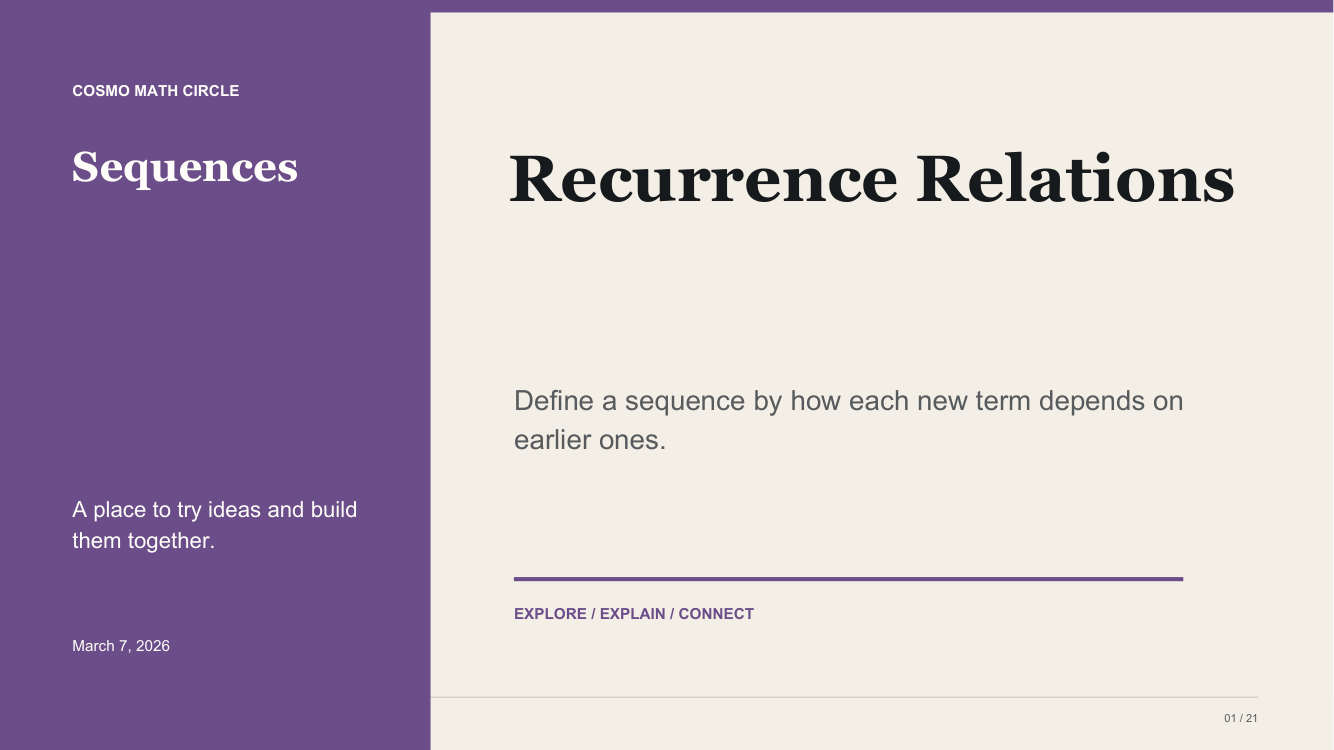
Recurrence Relations teaching deck cover
Sequences Intermediate 21 slides Published March 7, 2026
AlgebraMathematics

Recurrence Relations

Define a sequence by how each new term depends on earlier ones.

View teaching arc
  • Try a small case and record every step.
  • Separate what changes from what stays fixed.
  • State the pattern in a sentence before naming the theorem.
Students work through
  • A sequence starts 2, 5 and each term is the sum of the previous two. Find the next four terms.
  • Solve a_n = a_(n-1) + 3 with a_1 = 4.
  • Find a recurrence for the number of binary strings of length n with no consecutive 1s.
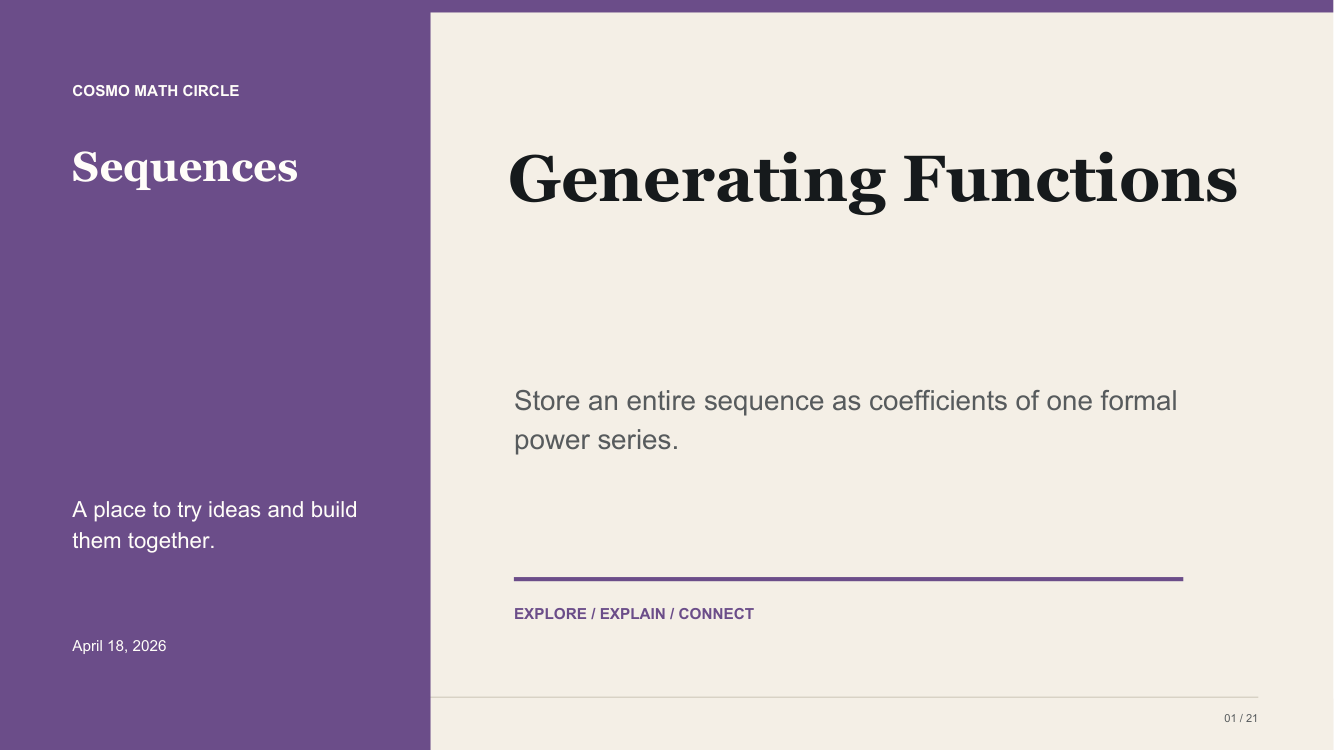
Generating Functions teaching deck cover
Sequences Advanced enrichment 21 slides Published April 18, 2026
AlgebraMathematics

Generating Functions

Store an entire sequence as coefficients of one formal power series.

View teaching arc
  • Try a small case and record every step.
  • Separate what changes from what stays fixed.
  • State the pattern in a sentence before naming the theorem.
Students work through
  • What sequence is encoded by 1/(1-x)?
  • Find the generating function for 0,1,2,3,... .
  • Use generating functions to count ways to make n using 1s and 2s.
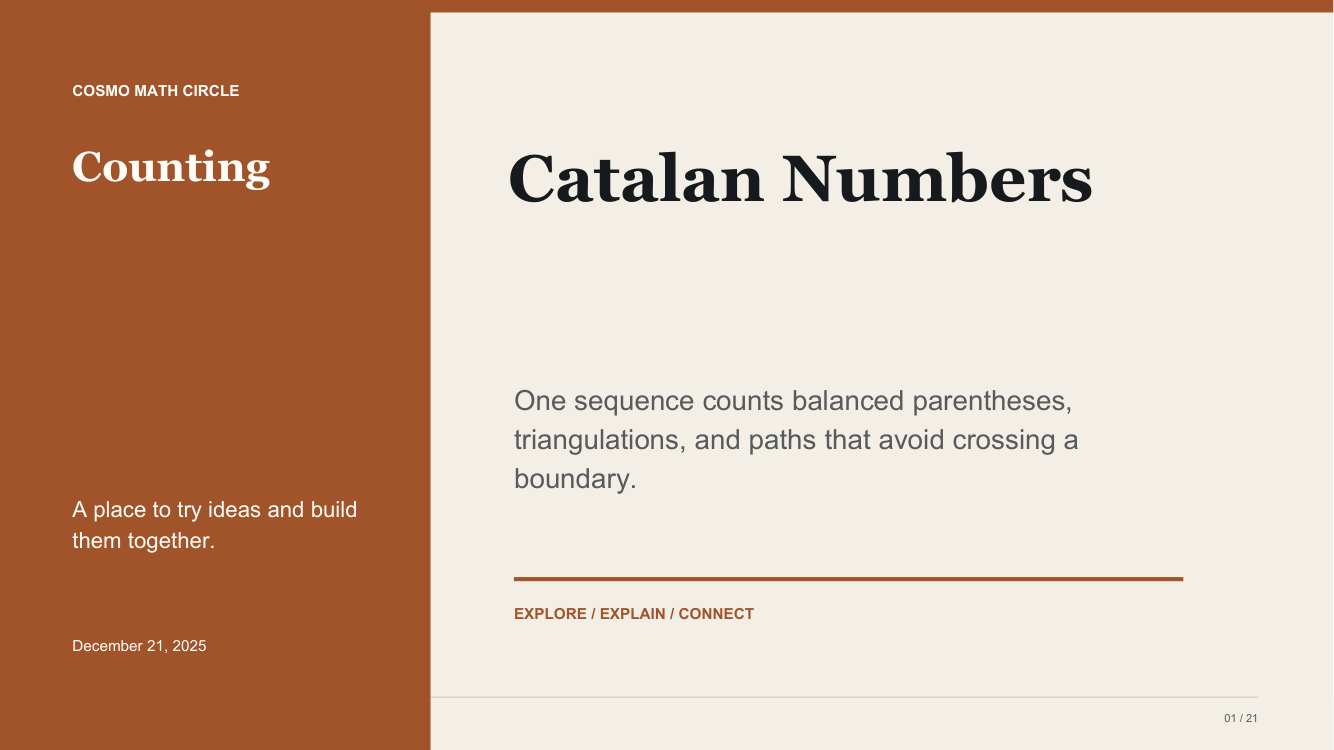
Catalan Numbers teaching deck cover
Counting Advanced enrichment 21 slides Published December 21, 2025
CountingCombinatoricsMathematics

Catalan Numbers

One sequence counts balanced parentheses, triangulations, and paths that avoid crossing a boundary.

View teaching arc
  • Try a small case and record every step.
  • Separate what changes from what stays fixed.
  • State the pattern in a sentence before naming the theorem.
Students work through
  • How many balanced parenthesis strings use three pairs?
  • Compute C_4 from C_n = (1/(n+1)) C(2n,n).
  • Explain the Catalan recurrence C_(n+1) = sum C_i C_(n-i).
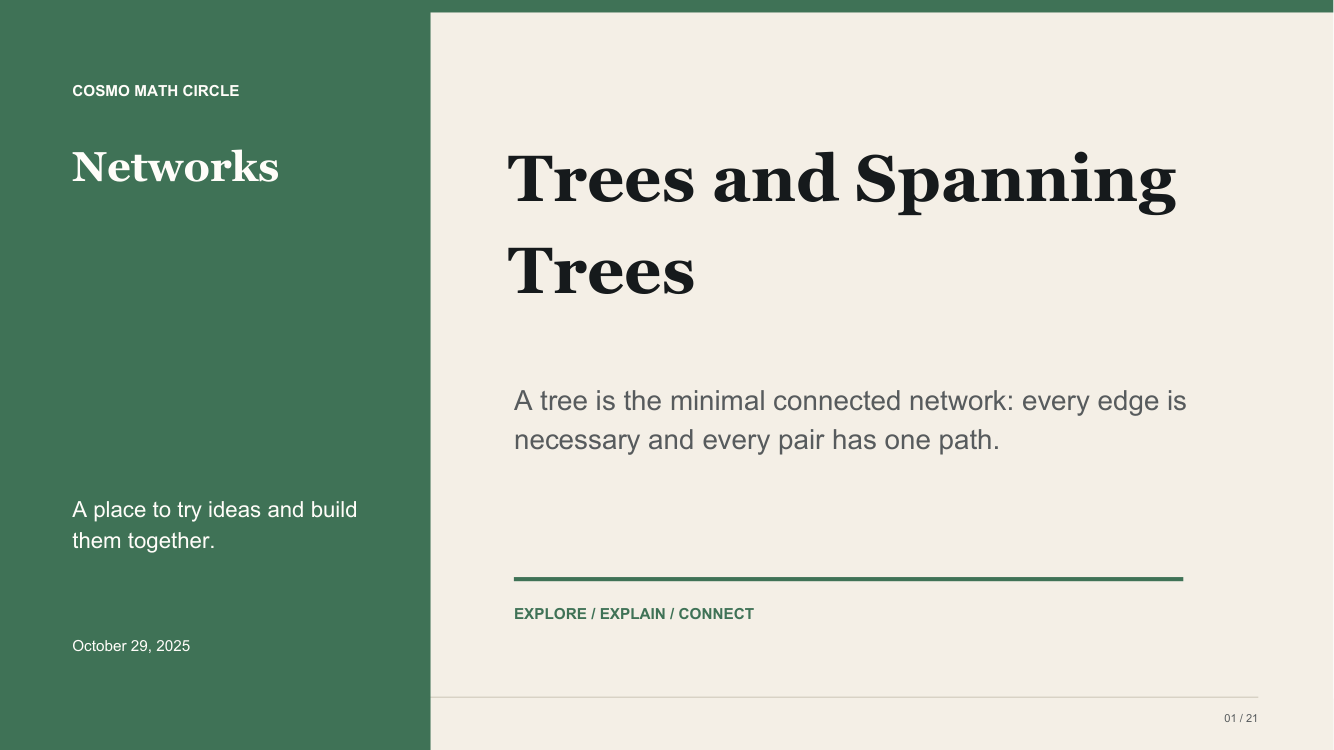
Trees and Spanning Trees teaching deck cover
Networks Intermediate 21 slides Published October 29, 2025
Graph TheoryMathematicsComputer Science

Trees and Spanning Trees

A tree is the minimal connected network: every edge is necessary and every pair has one path.

View teaching arc
  • Try a small case and record every step.
  • Separate what changes from what stays fixed.
  • State the pattern in a sentence before naming the theorem.
Students work through
  • A tree has 17 vertices. How many edges does it have?
  • Prove that removing any edge from a tree disconnects it.
  • Find a spanning tree of a square with both diagonals.
Planar Graphs teaching deck cover
Networks Intermediate 21 slides Published December 13, 2025
Graph TheoryMathematicsComputer Science

Planar Graphs

Use faces and Euler's formula to prove that some networks cannot be drawn without crossings.

View teaching arc
  • Try a small case and record every step.
  • Separate what changes from what stays fixed.
  • State the pattern in a sentence before naming the theorem.
Students work through
  • A connected planar graph has V=8 and E=12. How many faces?
  • Use Euler's formula to check a cube graph.
  • Show that a simple planar graph with V>=3 has E<=3V-6.
Graph Coloring teaching deck cover
Networks Intermediate 21 slides Published January 11, 2026
Graph TheoryMathematicsComputer Science

Graph Coloring

Assign limited labels so adjacent objects never conflict.

View teaching arc
  • Try a small case and record every step.
  • Separate what changes from what stays fixed.
  • State the pattern in a sentence before naming the theorem.
Students work through
  • How many colors does an odd cycle require?
  • Color a six-cycle with the fewest colors.
  • Explain why a graph containing K_4 needs at least four colors.
Matchings teaching deck cover
Networks Intermediate 21 slides Published February 8, 2026
Graph TheoryMathematicsComputer Science

Matchings

Pair vertices without reuse and use neighborhood conditions to test whether everyone can be matched.

View teaching arc
  • Try a small case and record every step.
  • Separate what changes from what stays fixed.
  • State the pattern in a sentence before naming the theorem.
Students work through
  • Can a graph with an odd number of vertices have a perfect matching?
  • Improve a matching using an augmenting path of length three.
  • Test whether three students can receive three distinct projects from their allowed lists.
Shortest Paths teaching deck cover
Algorithms Beginner to intermediate 21 slides Published February 22, 2026
AlgorithmsComputer Science

Shortest Paths

Build optimal routes by proving when a partial distance is final.

View teaching arc
  • Try a small case and record every step.
  • Separate what changes from what stays fixed.
  • State the pattern in a sentence before naming the theorem.
Students work through
  • Why can breadth-first search find shortest paths in an unweighted graph?
  • Run Dijkstra's algorithm on edges AB=2, AC=5, BC=1, BD=4, CD=1 from A.
  • Why does Dijkstra fail with negative edges?
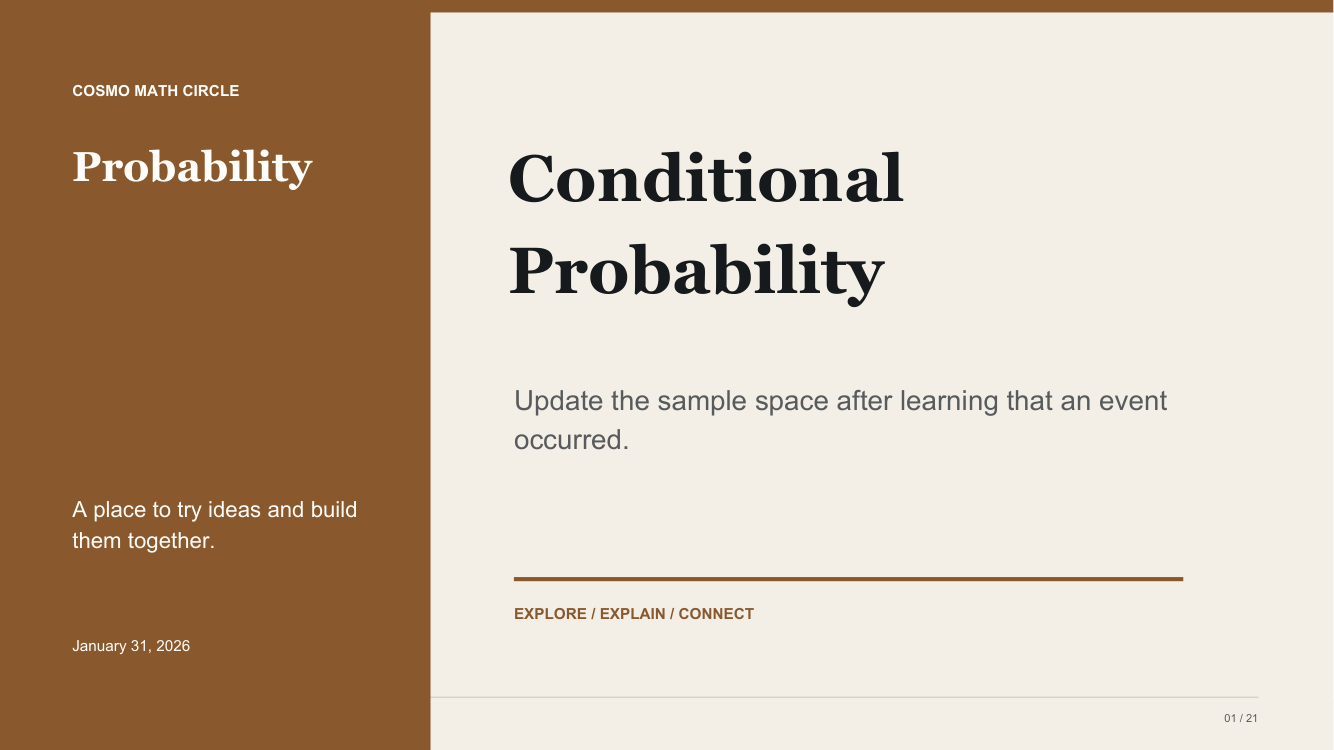
Conditional Probability teaching deck cover
Probability Beginner to intermediate 21 slides Published January 31, 2026
ProbabilityMathematics

Conditional Probability

Update the sample space after learning that an event occurred.

View teaching arc
  • Try a small case and record every step.
  • Separate what changes from what stays fixed.
  • State the pattern in a sentence before naming the theorem.
Students work through
  • A card is known to be a face card. What is the probability it is a king?
  • Compute P(A|B) when P(A and B)=0.18 and P(B)=0.30.
  • Two fair dice are rolled. Given that the sum is 8, find P(first die is 3).
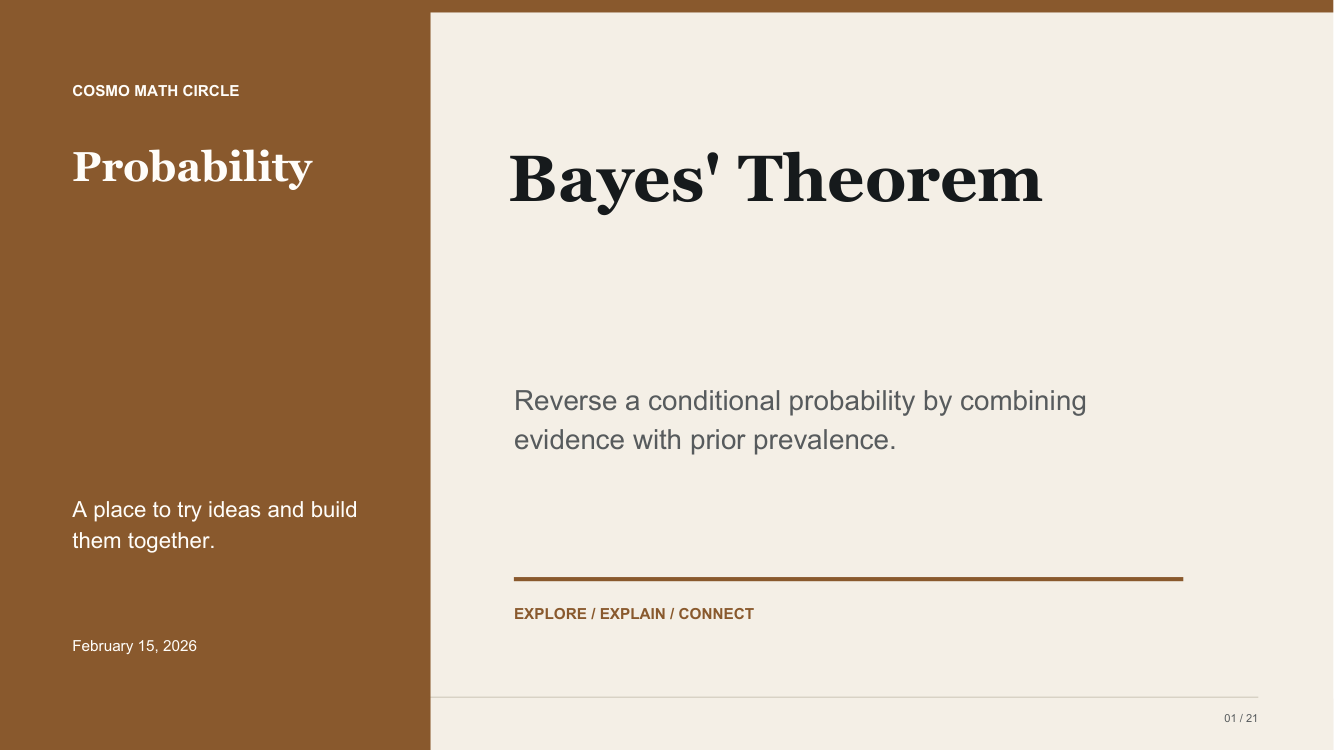
Bayes' Theorem teaching deck cover
Probability Intermediate 21 slides Published February 15, 2026
ProbabilityMathematics

Bayes' Theorem

Reverse a conditional probability by combining evidence with prior prevalence.

View teaching arc
  • Try a small case and record every step.
  • Separate what changes from what stays fixed.
  • State the pattern in a sentence before naming the theorem.
Students work through
  • Why can a 99 percent accurate test still produce many false positives for a rare condition?
  • A condition affects 1 percent, sensitivity is 90 percent, and false-positive rate is 5 percent. Find P(condition|positive).
  • A bag is chosen equally: bag A has 2 red, 1 blue; bag B has 1 red, 2 blue. Given red, find P(A).
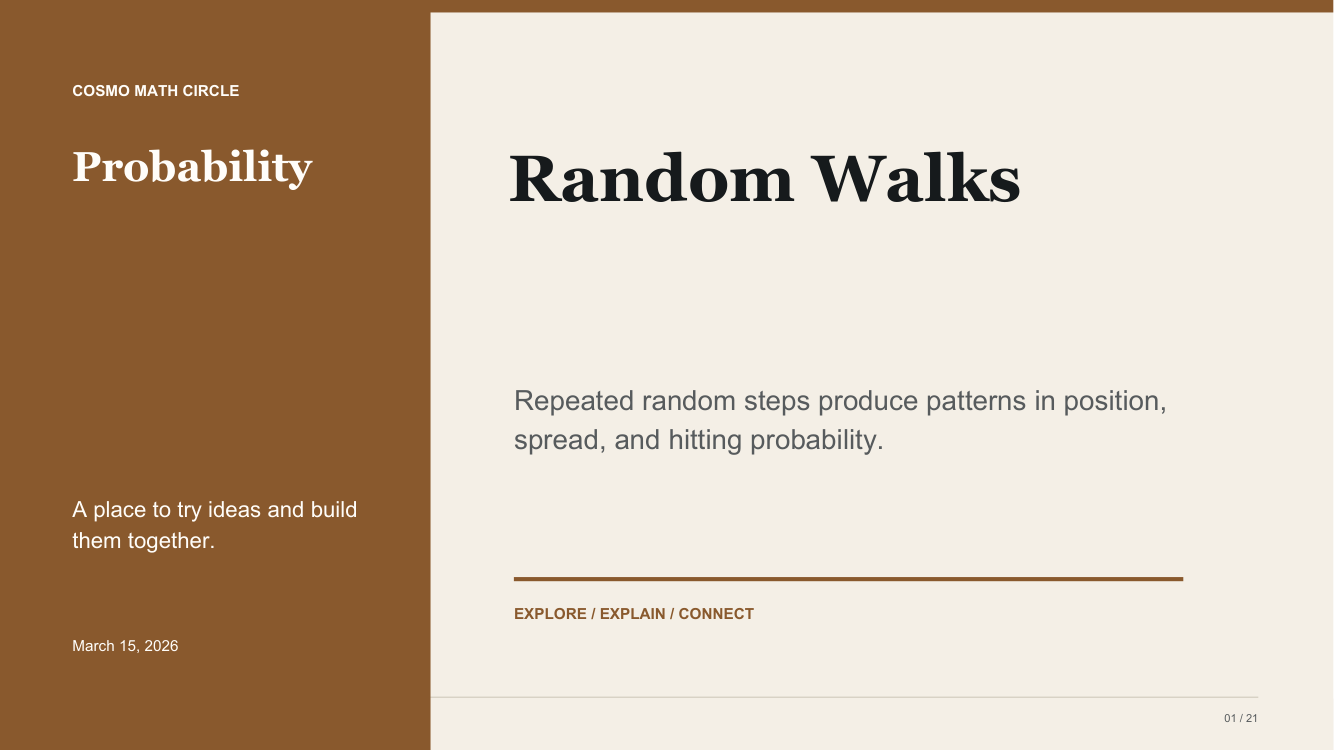
Random Walks teaching deck cover
Probability Intermediate 21 slides Published March 15, 2026
ProbabilityMathematics

Random Walks

Repeated random steps produce patterns in position, spread, and hitting probability.

View teaching arc
  • Try a small case and record every step.
  • Separate what changes from what stays fixed.
  • State the pattern in a sentence before naming the theorem.
Students work through
  • After four fair left-right steps, what is the probability of returning to the start?
  • Find the expected position after n fair steps from 0.
  • Find the probability of position 2 after six fair steps.
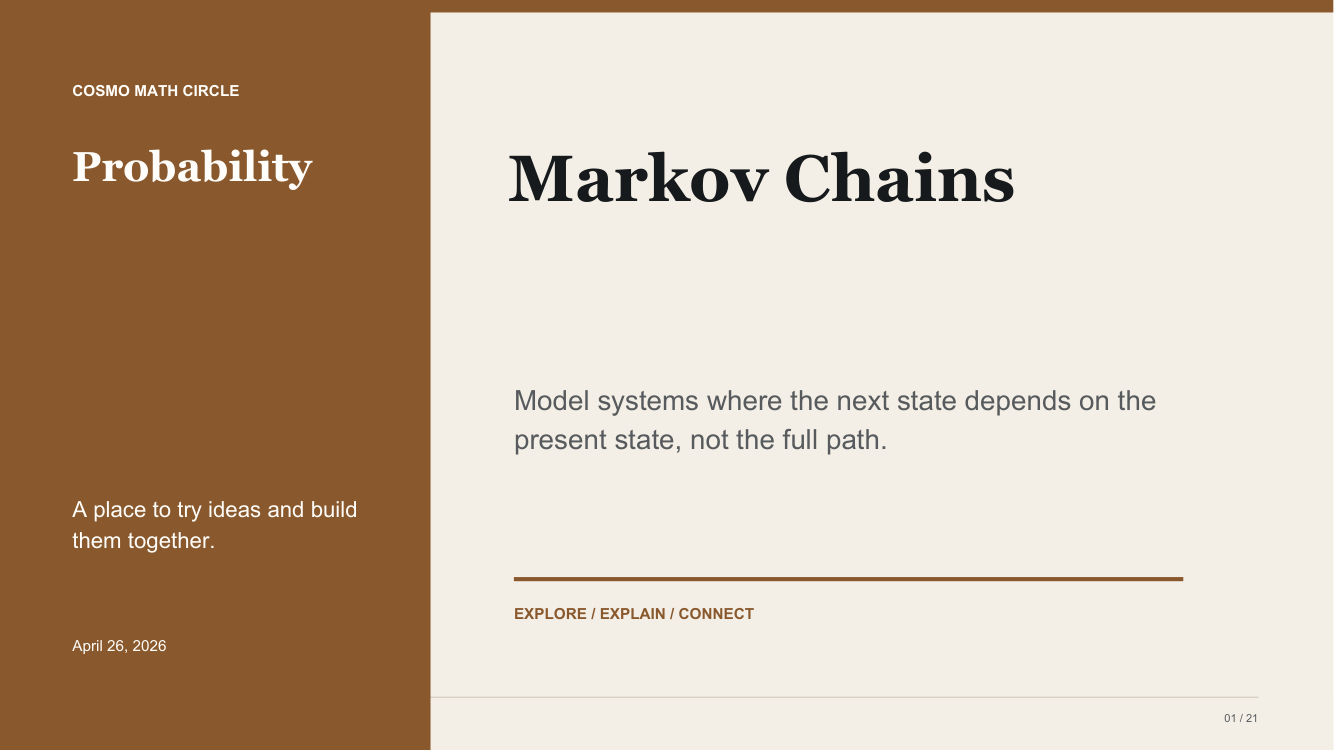
Markov Chains teaching deck cover
Probability Intermediate 21 slides Published April 26, 2026
ProbabilityMathematics

Markov Chains

Model systems where the next state depends on the present state, not the full path.

View teaching arc
  • Try a small case and record every step.
  • Separate what changes from what stays fixed.
  • State the pattern in a sentence before naming the theorem.
Students work through
  • A two-state chain switches states with probability 0.2 each step. What fraction of time is spent in each state long-run?
  • Update distribution (0.7,0.3) using matrix [[0.8,0.2],[0.4,0.6]].
  • Find the stationary distribution for [[0.9,0.1],[0.3,0.7]].
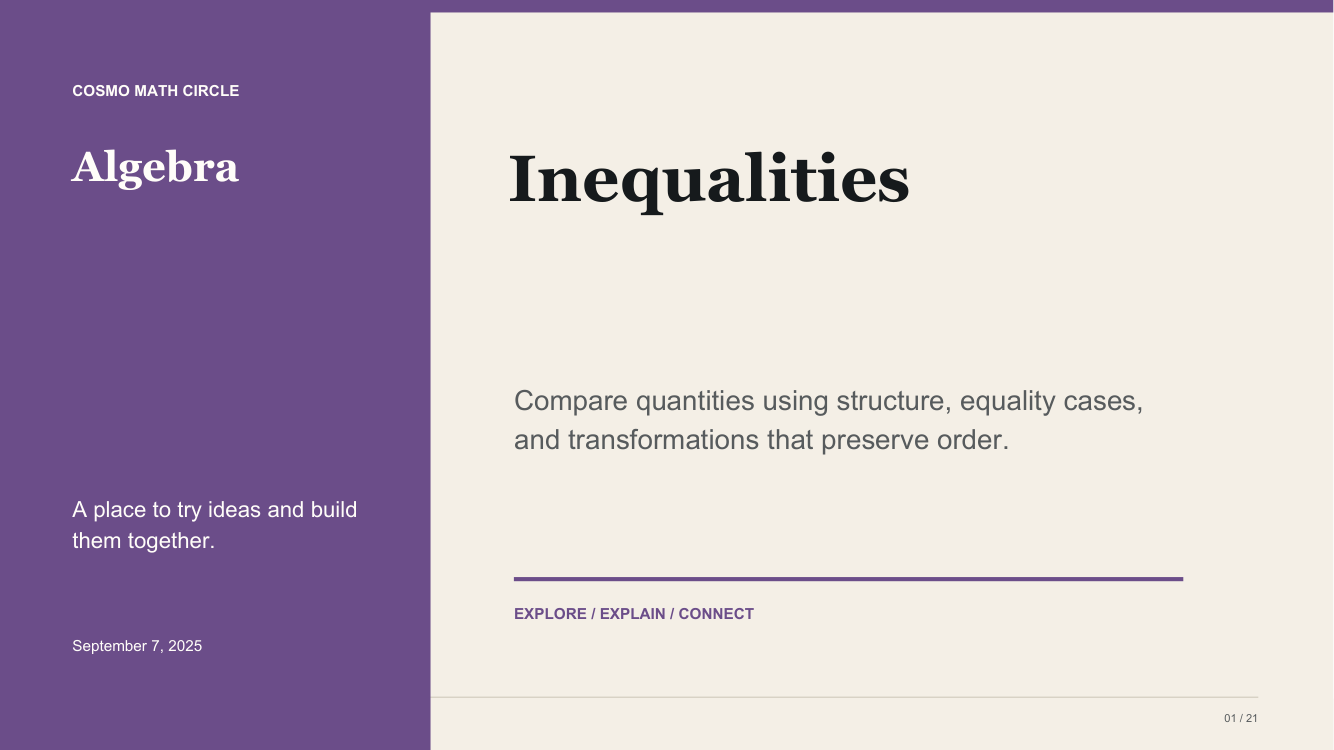
Inequalities teaching deck cover
Algebra Intermediate 21 slides Published September 7, 2025
AlgebraMathematics

Inequalities

Compare quantities using structure, equality cases, and transformations that preserve order.

View teaching arc
  • Try a small case and record every step.
  • Separate what changes from what stays fixed.
  • State the pattern in a sentence before naming the theorem.
Students work through
  • For positive a and b with a+b=10, what is the largest possible ab?
  • Prove (x-y)^2 >= 0 implies x^2+y^2 >= 2xy.
  • Find the minimum of x + 16/x for x>0.
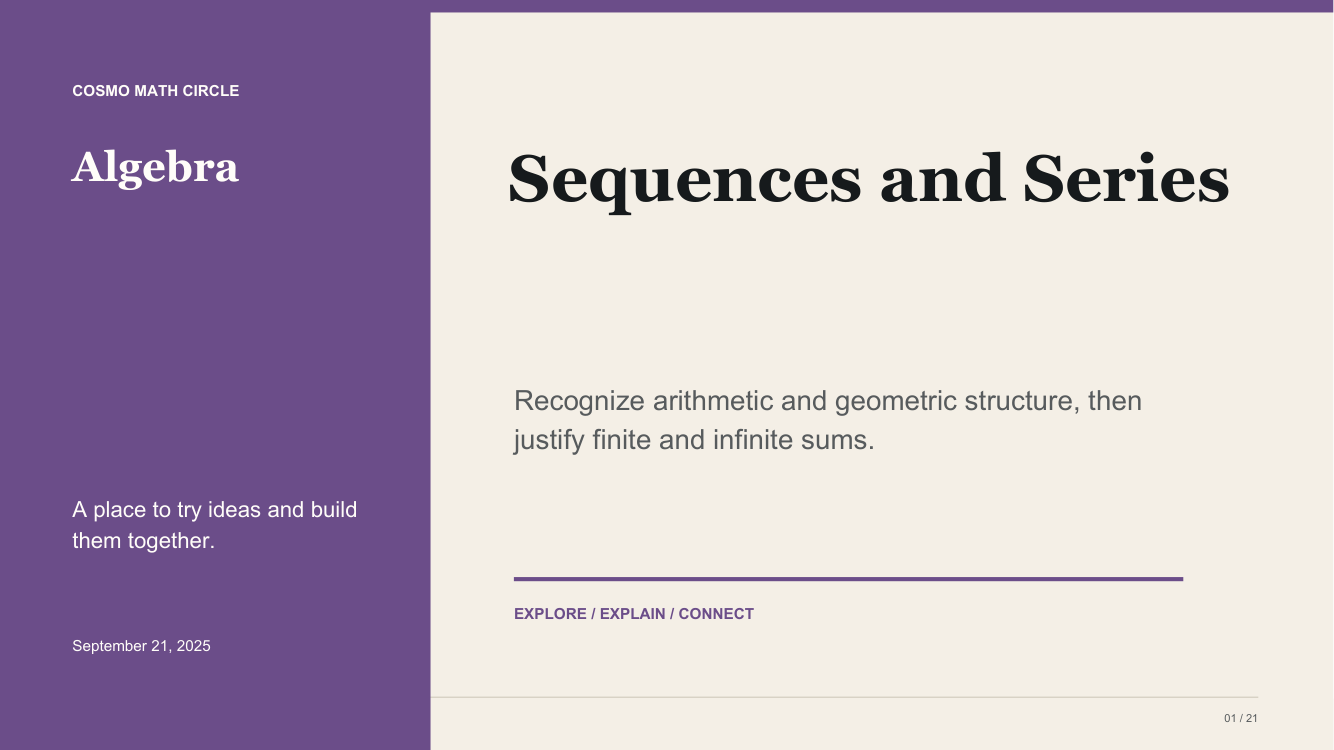
Sequences and Series teaching deck cover
Algebra Beginner to intermediate 21 slides Published September 21, 2025
AlgebraMathematics

Sequences and Series

Recognize arithmetic and geometric structure, then justify finite and infinite sums.

View teaching arc
  • Try a small case and record every step.
  • Separate what changes from what stays fixed.
  • State the pattern in a sentence before naming the theorem.
Students work through
  • Find the 20th term of 7, 11, 15, ... .
  • Find the sum 3 + 6 + ... + 60.
  • Find the sum 1 + 1/3 + 1/9 + ... .
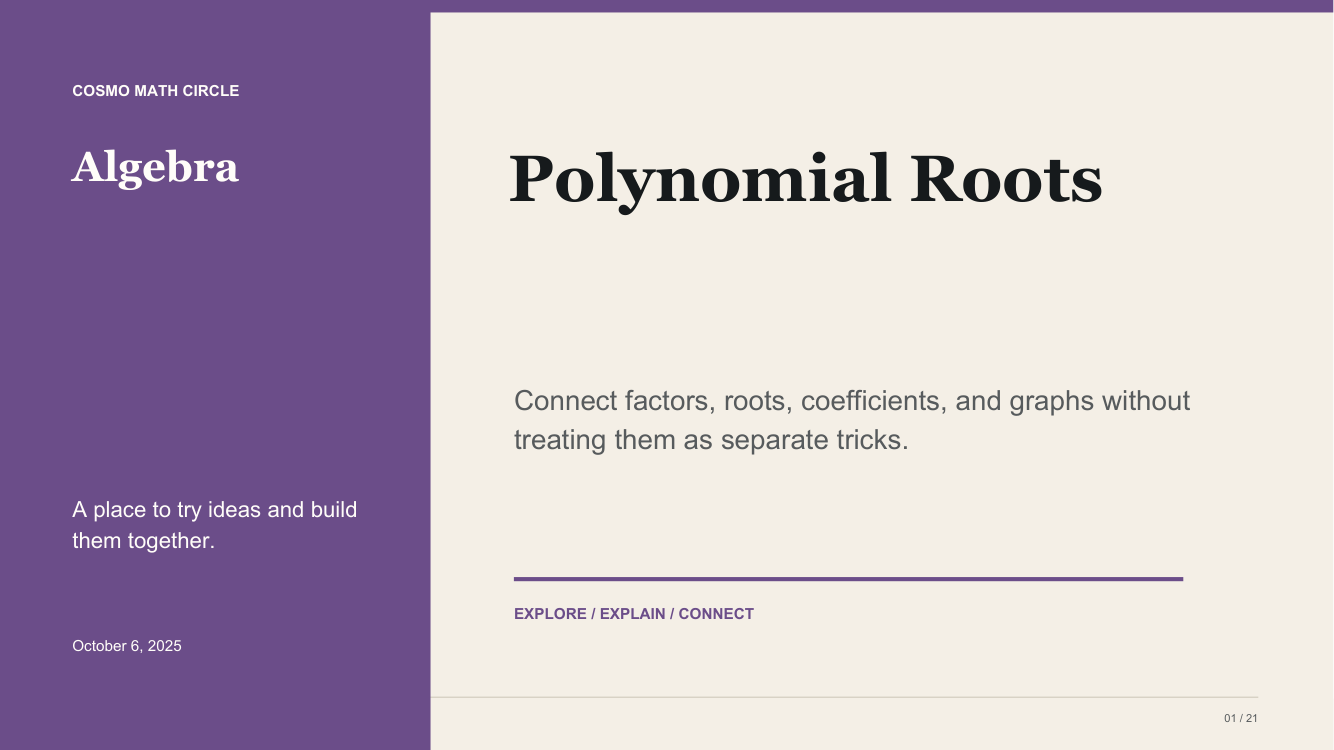
Polynomial Roots teaching deck cover
Algebra Intermediate 21 slides Published October 6, 2025
AlgebraMathematics

Polynomial Roots

Connect factors, roots, coefficients, and graphs without treating them as separate tricks.

View teaching arc
  • Try a small case and record every step.
  • Separate what changes from what stays fixed.
  • State the pattern in a sentence before naming the theorem.
Students work through
  • If 3 is a root of p(x), what factor must p(x) have?
  • Factor x^3 - 4x^2 - x + 4.
  • A monic quadratic has roots 2 and -5. Find it.
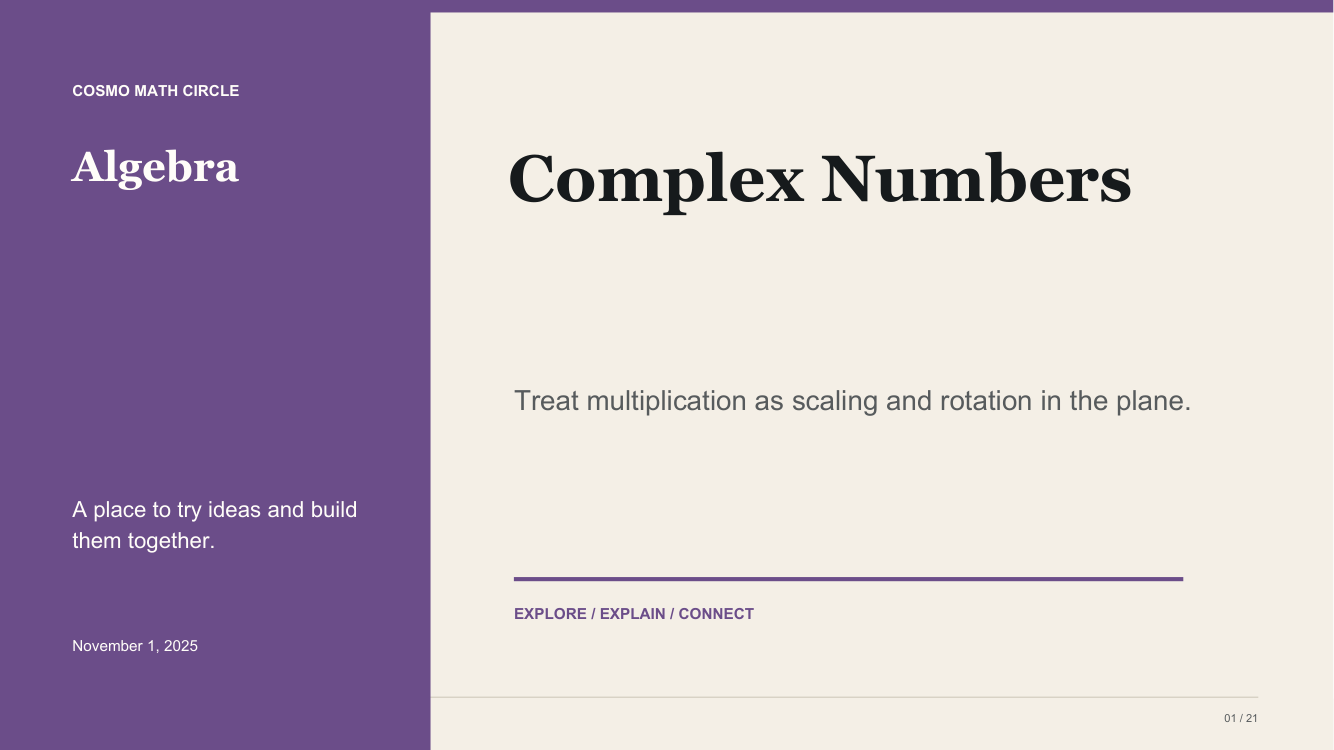
Complex Numbers teaching deck cover
Algebra Beginner to intermediate 21 slides Published November 1, 2025
AlgebraMathematics

Complex Numbers

Treat multiplication as scaling and rotation in the plane.

View teaching arc
  • Try a small case and record every step.
  • Separate what changes from what stays fixed.
  • State the pattern in a sentence before naming the theorem.
Students work through
  • Compute (3+2i)(1-i).
  • Find the modulus of -3+4i.
  • Solve z^2 = -16.
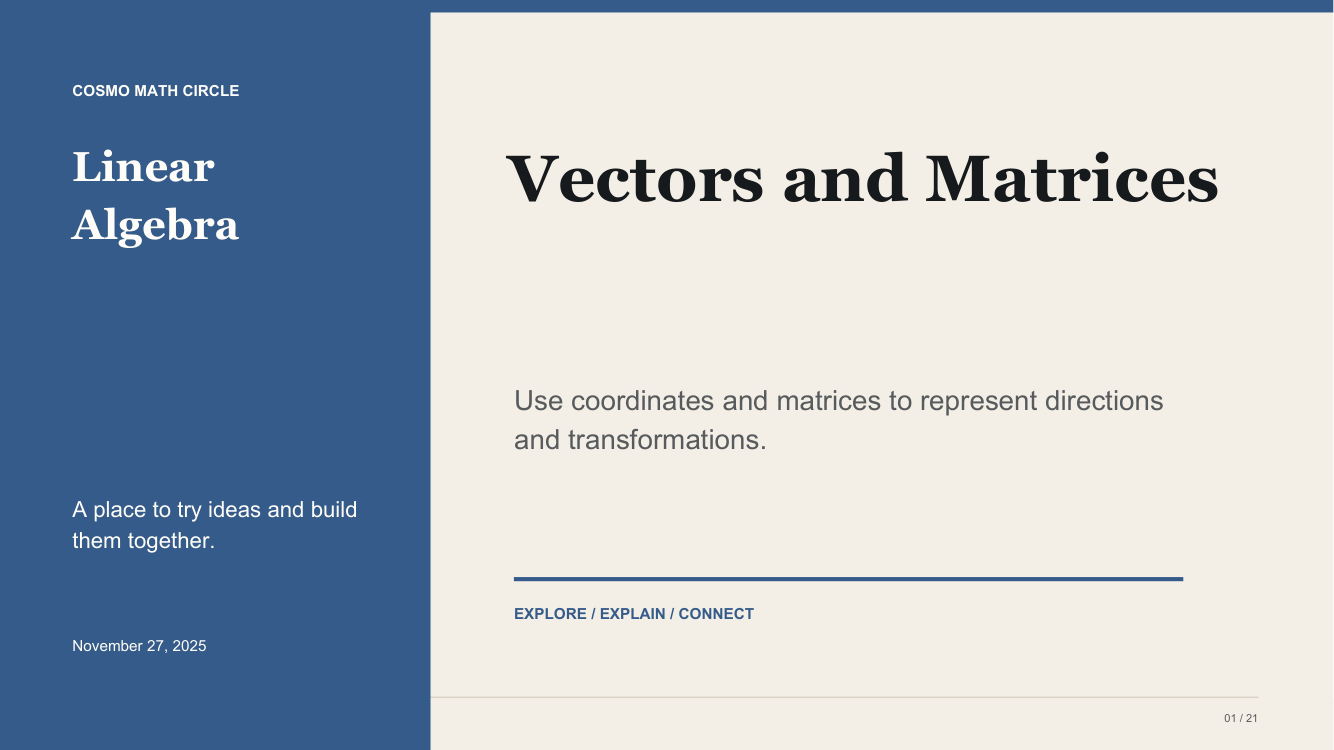
Vectors and Matrices teaching deck cover
Linear Algebra Beginner to intermediate 21 slides Published November 27, 2025
AlgebraMathematics

Vectors and Matrices

Use coordinates and matrices to represent directions and transformations.

View teaching arc
  • Try a small case and record every step.
  • Separate what changes from what stays fixed.
  • State the pattern in a sentence before naming the theorem.
Students work through
  • Add vectors (3,-1) and (-2,5).
  • Apply matrix [[2,0],[0,-1]] to vector (3,4).
  • Find the determinant of [[3,2],[1,4]].
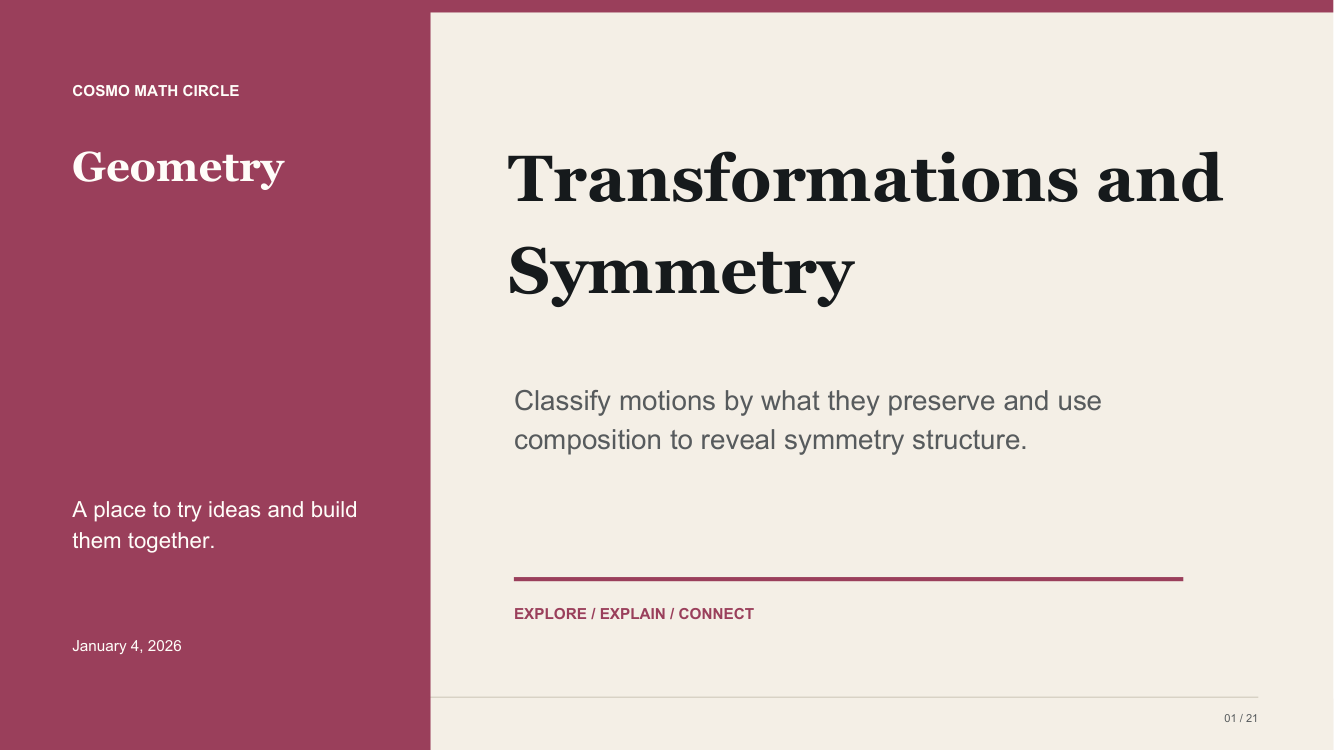
Transformations and Symmetry teaching deck cover
Geometry Beginner friendly 21 slides Published January 4, 2026
GeometryMathematics

Transformations and Symmetry

Classify motions by what they preserve and use composition to reveal symmetry structure.

View teaching arc
  • Try a small case and record every step.
  • Separate what changes from what stays fixed.
  • State the pattern in a sentence before naming the theorem.
Students work through
  • How many rotational symmetries does a regular hexagon have?
  • Reflect point (3,-2) across the y-axis.
  • Compose two reflections across parallel vertical lines x=0 and x=2.
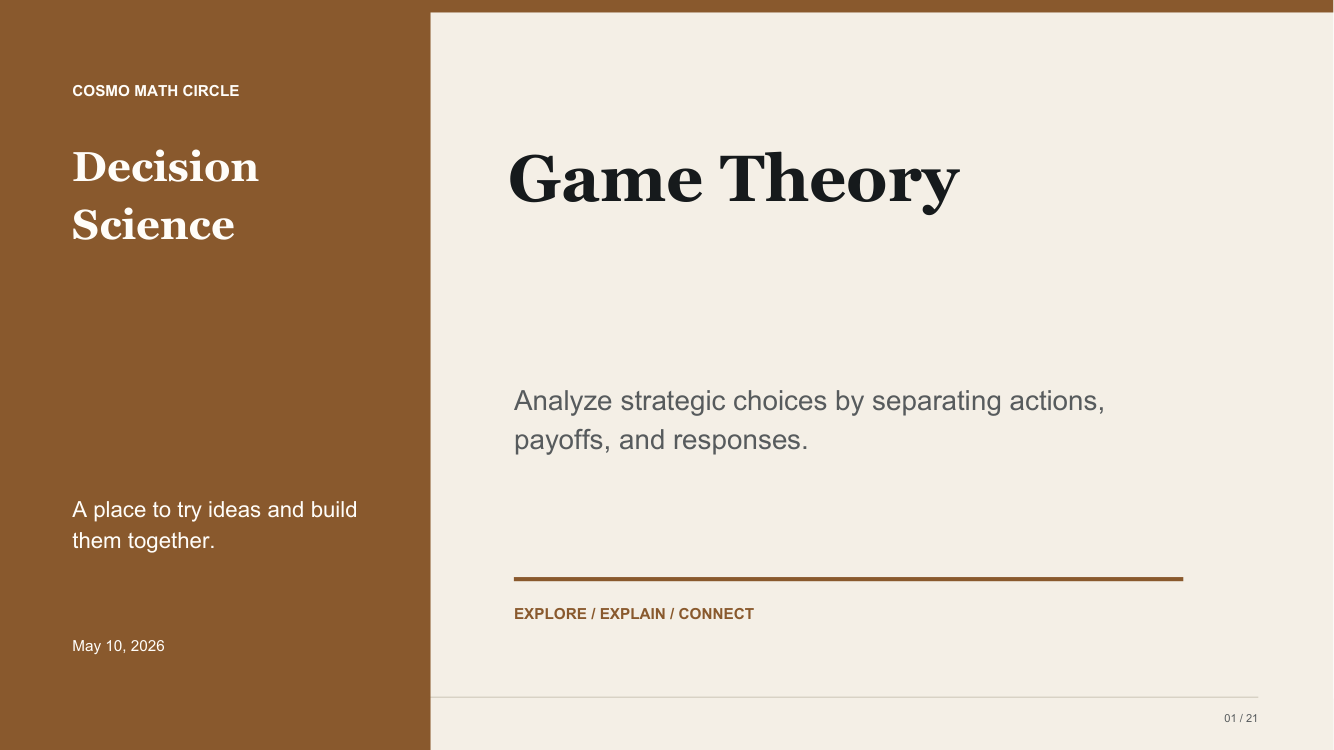
Game Theory teaching deck cover
Decision Science Intermediate 21 slides Published May 10, 2026
Game TheoryApplied Math

Game Theory

Analyze strategic choices by separating actions, payoffs, and responses.

View teaching arc
  • Try a small case and record every step.
  • Separate what changes from what stays fixed.
  • State the pattern in a sentence before naming the theorem.
Students work through
  • In rock-paper-scissors, does any pure strategy dominate?
  • Find pure Nash equilibria in a coordination game with payoffs (2,2) on A,A; (1,1) on B,B; and (0,0) off diagonal.
  • Identify a dominant strategy in a two-action payoff table.
Greedy Algorithms teaching deck cover
Algorithms Intermediate 21 slides Published March 28, 2026
AlgorithmsComputer Science

Greedy Algorithms

Make locally best choices only when an exchange argument proves they can form a global optimum.

View teaching arc
  • Try a small case and record every step.
  • Separate what changes from what stays fixed.
  • State the pattern in a sentence before naming the theorem.
Students work through
  • Does choosing the largest coin always minimize coin count?
  • Use earliest-finish-time greedy selection for intervals [1,4],[3,5],[0,6],[5,7],[8,9].
  • Explain the exchange argument for interval scheduling.
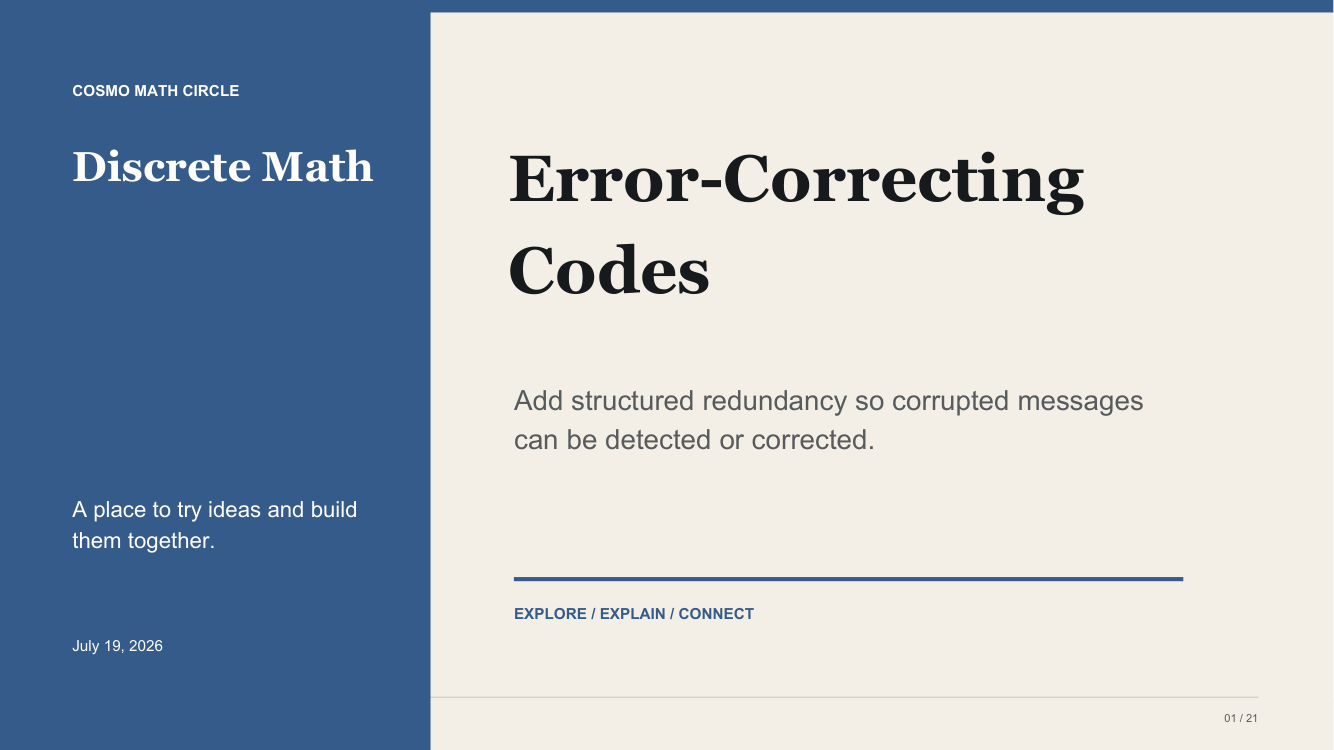
Error-Correcting Codes teaching deck cover
Discrete Math Intermediate 21 slides Published July 19, 2026
Computer ScienceMathematics

Error-Correcting Codes

Add structured redundancy so corrupted messages can be detected or corrected.

View teaching arc
  • Try a small case and record every step.
  • Separate what changes from what stays fixed.
  • State the pattern in a sentence before naming the theorem.
Students work through
  • What is the Hamming distance between 101101 and 111001?
  • Use an even parity bit for message 1011.
  • How many errors can a code with minimum distance 5 correct?
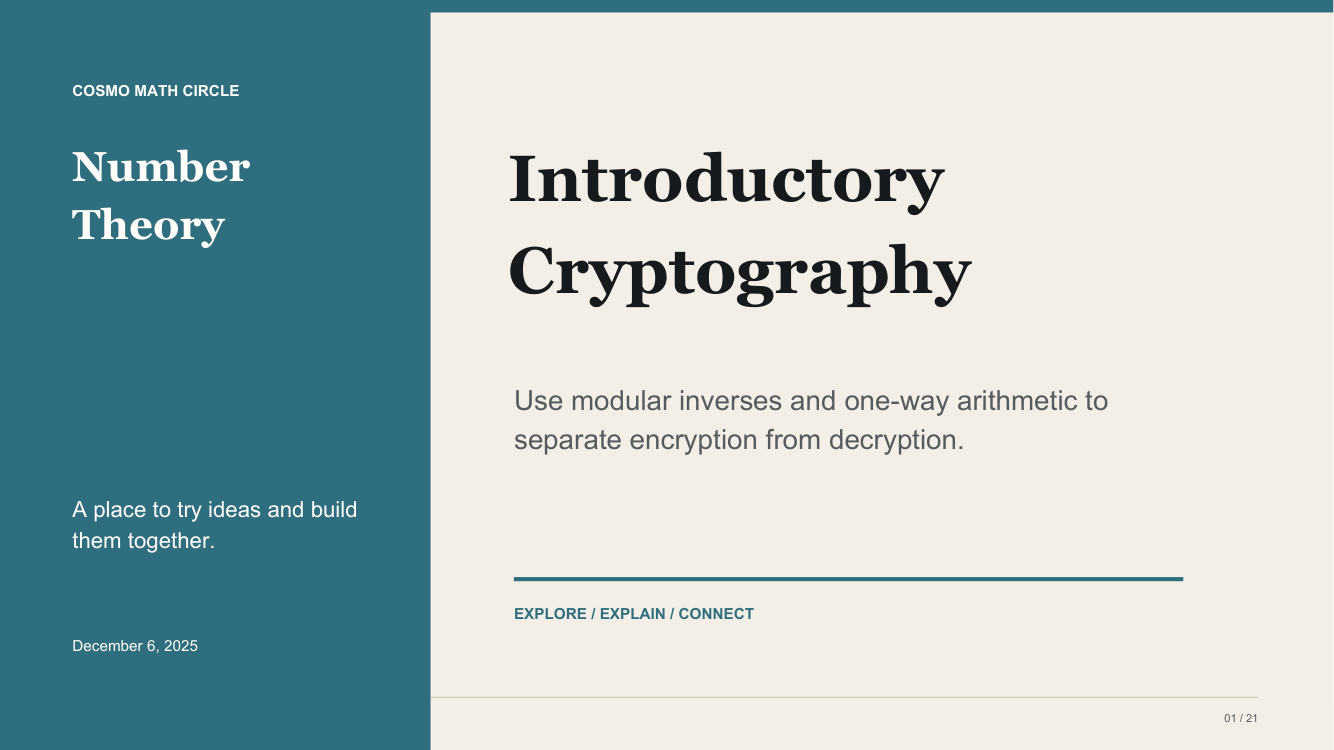
Introductory Cryptography teaching deck cover
Number Theory Intermediate 21 slides Published December 6, 2025
Number TheoryMathematics

Introductory Cryptography

Use modular inverses and one-way arithmetic to separate encryption from decryption.

View teaching arc
  • Try a small case and record every step.
  • Separate what changes from what stays fixed.
  • State the pattern in a sentence before naming the theorem.
Students work through
  • Encrypt letter value 7 with affine rule E(x)=5x+8 mod 26.
  • Find the inverse of 5 mod 26.
  • Decrypt y=17 from E(x)=5x+8 mod 26.
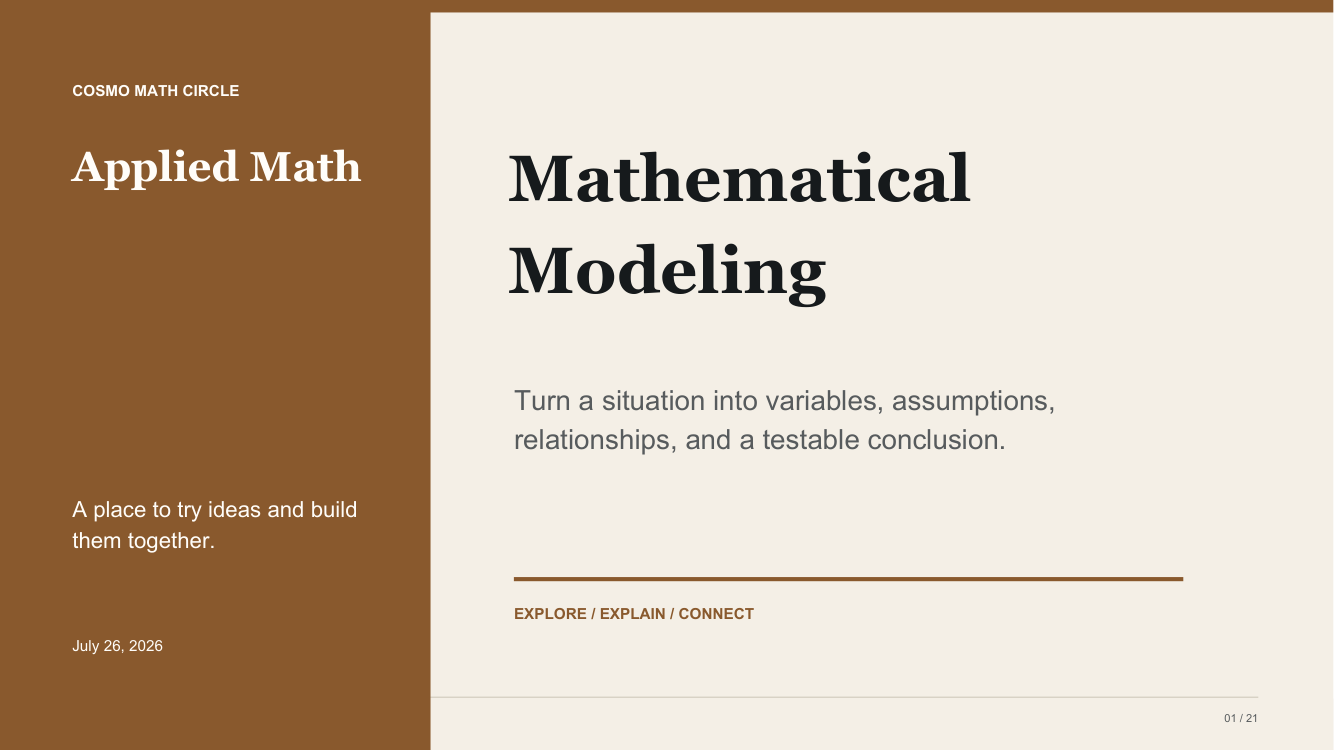
Mathematical Modeling teaching deck cover
Applied Math Beginner to intermediate 21 slides Published July 26, 2026
Applied MathMathematics

Mathematical Modeling

Turn a situation into variables, assumptions, relationships, and a testable conclusion.

View teaching arc
  • Try a small case and record every step.
  • Separate what changes from what stays fixed.
  • State the pattern in a sentence before naming the theorem.
Students work through
  • A taxi charges $3 plus $2 per mile. Write and interpret a cost model.
  • Model water draining at a constant 4 liters per minute from 100 liters.
  • Compare linear and exponential growth for an account increasing by $100 yearly versus 5 percent yearly.
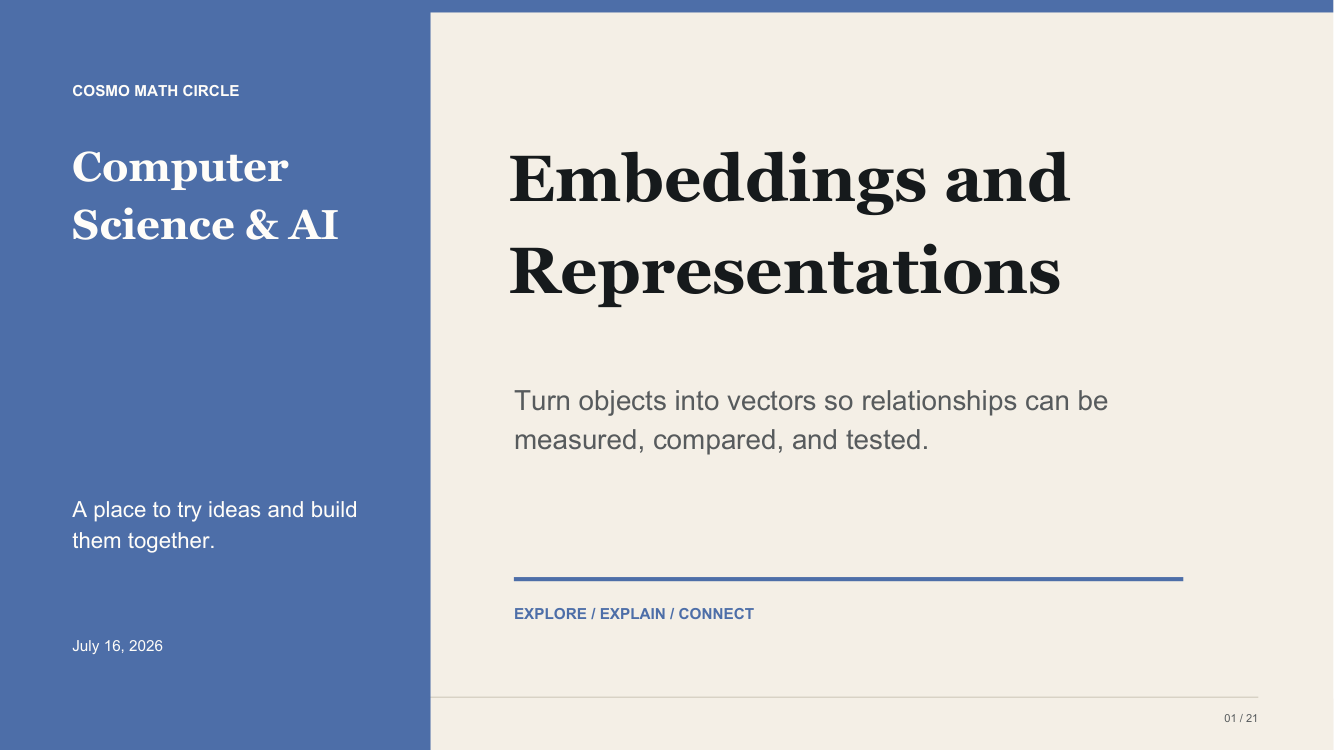
Embeddings and Representations teaching deck cover
Computer Science & AI Beginner to intermediate 21 slides Published July 16, 2026
Computer ScienceMachine LearningEmbeddingsLinear Algebra

Embeddings and Representations

Turn objects into vectors so relationships can be measured, compared, and tested.

View teaching arc
  • Try a small case and record every step.
  • Separate what changes from what stays fixed.
  • State the pattern in a sentence before naming the theorem.
Students work through
  • A model maps cat to (1.0, 0.9), dog to (0.9, 1.0), and bicycle to (-0.8, -0.7). What relationship is the representation expressing?
  • Compare the vectors a=(1,2), b=(2,3), and c=(-3,-2) without naming the objects.
  • Design two features for representing short text messages.
Distance and Cosine Similarity teaching deck cover
Computer Science & AI Beginner to intermediate 21 slides Published July 10, 2026
Computer ScienceMachine LearningEmbeddingsLinear Algebra

Distance and Cosine Similarity

Compare vectors by absolute distance, direction, and the assumptions built into each metric.

View teaching arc
  • Try a small case and record every step.
  • Separate what changes from what stays fixed.
  • State the pattern in a sentence before naming the theorem.
Students work through
  • Vectors (1,1) and (2,2) point in the same direction. Are they identical under every comparison?
  • Find the L2 distance between u=(1,2) and v=(4,6).
  • Find the cosine similarity between a=(1,0) and b=(1,1).
Nearest Neighbors and Evaluation teaching deck cover
Computer Science & AI Intermediate 21 slides Published July 22, 2026
Computer ScienceMachine LearningEmbeddingsAlgorithms

Nearest Neighbors and Evaluation

Use local neighborhoods to retrieve examples and test whether an embedding preserves useful relationships.

View teaching arc
  • Try a small case and record every step.
  • Separate what changes from what stays fixed.
  • State the pattern in a sentence before naming the theorem.
Students work through
  • A query is at (0,0). Which point is nearest: A=(1,1), B=(2,0), or C=(-1,2)?
  • Classify q=(2,2) using the three nearest labeled points: red (1,2), red (2,1), blue (3,3).
  • Compare two embeddings on five known related pairs.
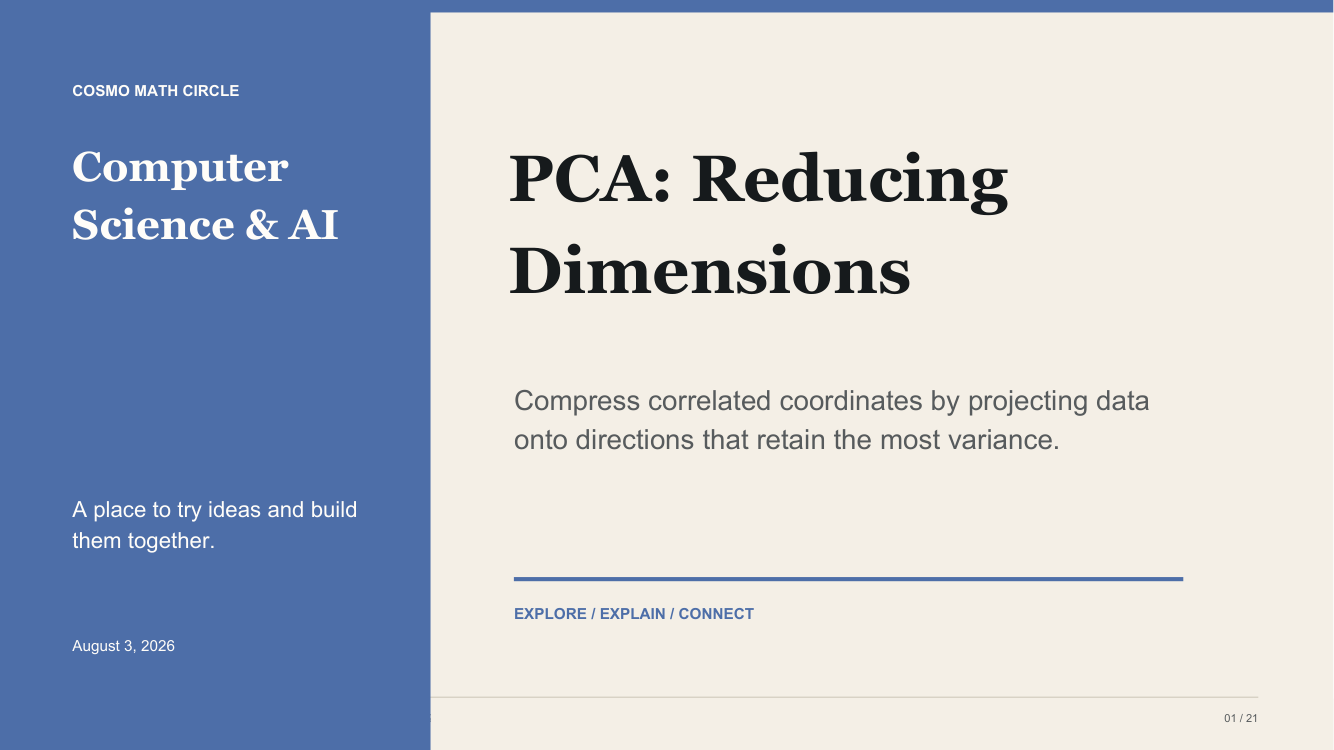
PCA: Reducing Dimensions teaching deck cover
Computer Science & AI Intermediate 21 slides Published August 3, 2026
Computer ScienceMachine LearningDimensionality ReductionLinear Algebra

PCA: Reducing Dimensions

Compress correlated coordinates by projecting data onto directions that retain the most variance.

View teaching arc
  • Try a small case and record every step.
  • Separate what changes from what stays fixed.
  • State the pattern in a sentence before naming the theorem.
Students work through
  • Points lie close to the line y=x. Which one-dimensional direction should preserve more spread: horizontal or diagonal?
  • Project centered points (-1,-1), (0,0), and (1,1) onto direction (1/sqrt(2),1/sqrt(2)).
  • A covariance matrix has eigenvalues 9, 3, and 1. What share does the first component explain?
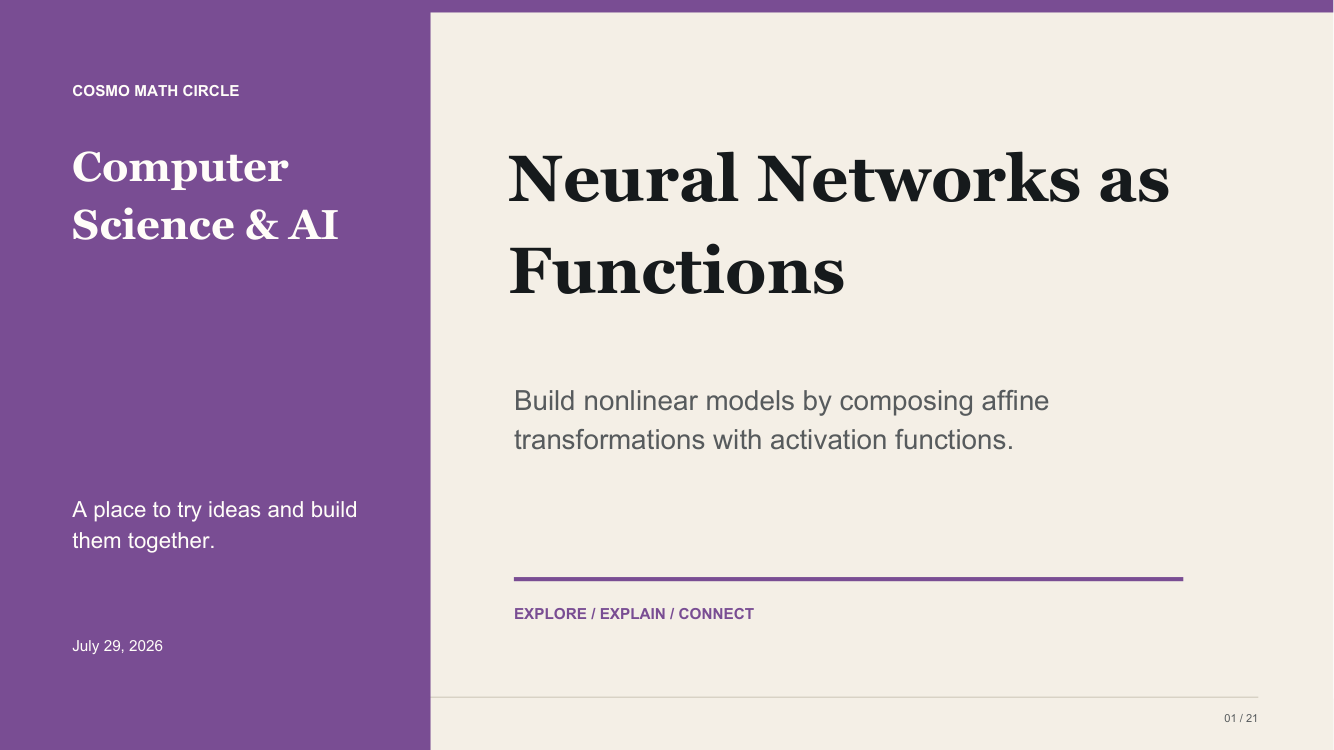
Neural Networks as Functions teaching deck cover
Computer Science & AI Intermediate 21 slides Published July 29, 2026
Computer ScienceMachine LearningNeural Networks

Neural Networks as Functions

Build nonlinear models by composing affine transformations with activation functions.

View teaching arc
  • Try a small case and record every step.
  • Separate what changes from what stays fixed.
  • State the pattern in a sentence before naming the theorem.
Students work through
  • For z=2x1-x2+0.5 with x=(1,3), what does a ReLU neuron output?
  • Evaluate h=ReLU(2x-1) and y=3h+2 at x=2.
  • Show why two linear layers without activations are still one linear transformation.
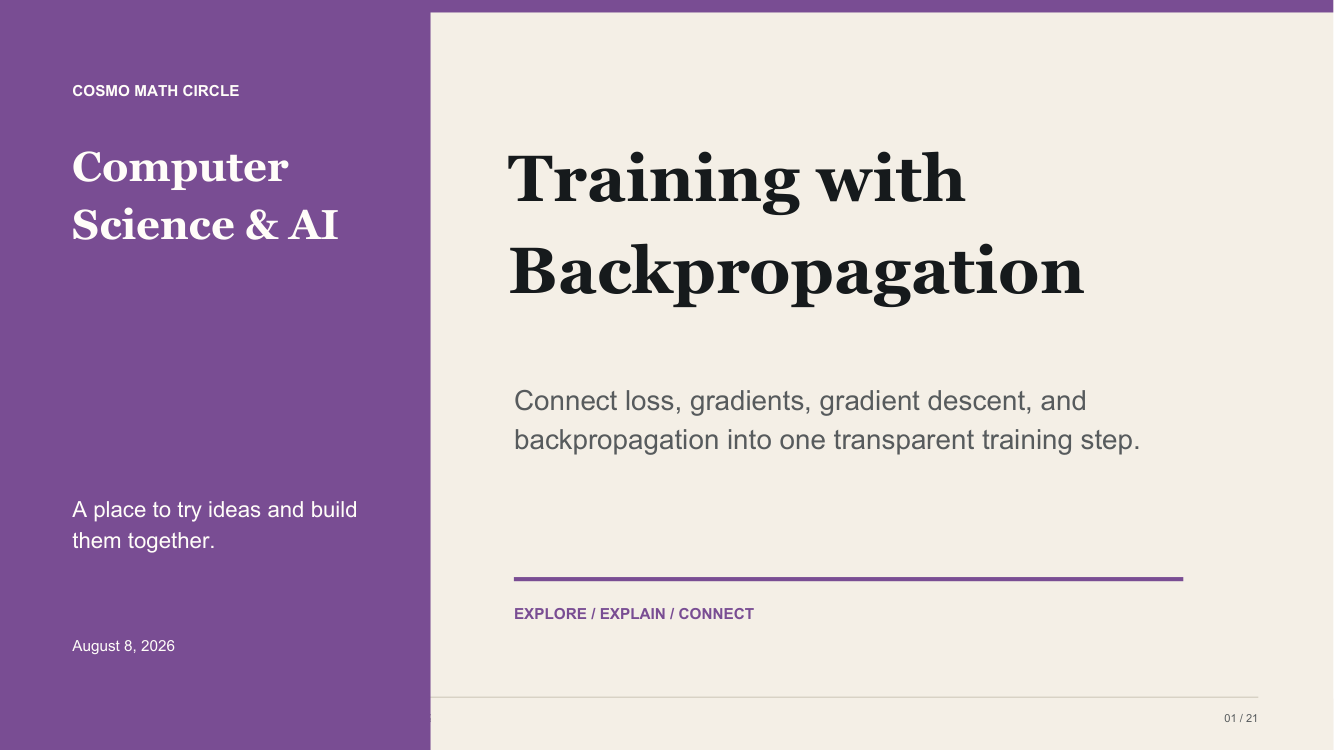
Training with Backpropagation teaching deck cover
Computer Science & AI Intermediate to advanced 21 slides Published August 8, 2026
Computer ScienceMachine LearningNeural NetworksOptimization

Training with Backpropagation

Connect loss, gradients, gradient descent, and backpropagation into one transparent training step.

View teaching arc
  • Try a small case and record every step.
  • Separate what changes from what stays fixed.
  • State the pattern in a sentence before naming the theorem.
Students work through
  • For prediction yhat=wx with x=2, target y=6, and w=1, what is the squared loss?
  • Take one gradient-descent step for L=(wx-y)^2 with x=2, y=6, w=1, and learning rate 0.1.
  • Backpropagate through yhat=w2(w1x) with x=1, y=6, w1=2, and w2=2.
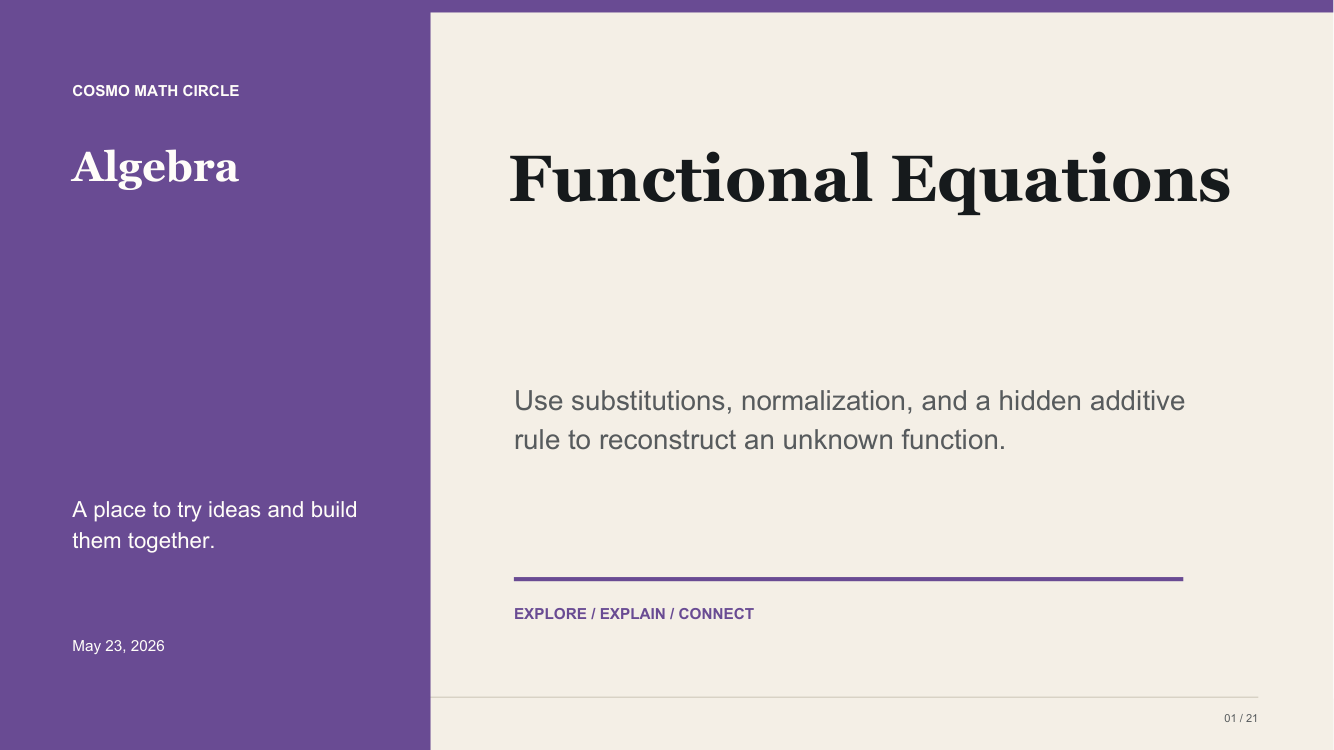
Functional Equations teaching deck cover
Algebra AMC / AIME enrichment 21 slides Published May 23, 2026
AlgebraAMCAIMEMathematics

Functional Equations

Use substitutions, normalization, and a hidden additive rule to reconstruct an unknown function.

View teaching arc
  • Test special inputs before guessing a formula.
  • Use a correction term to expose an additive rule.
  • Check the domain before extending a pattern.
Students work through
  • What does substituting 0 reveal?
  • Which correction cancels an xy term?
  • How does additivity determine integer values?
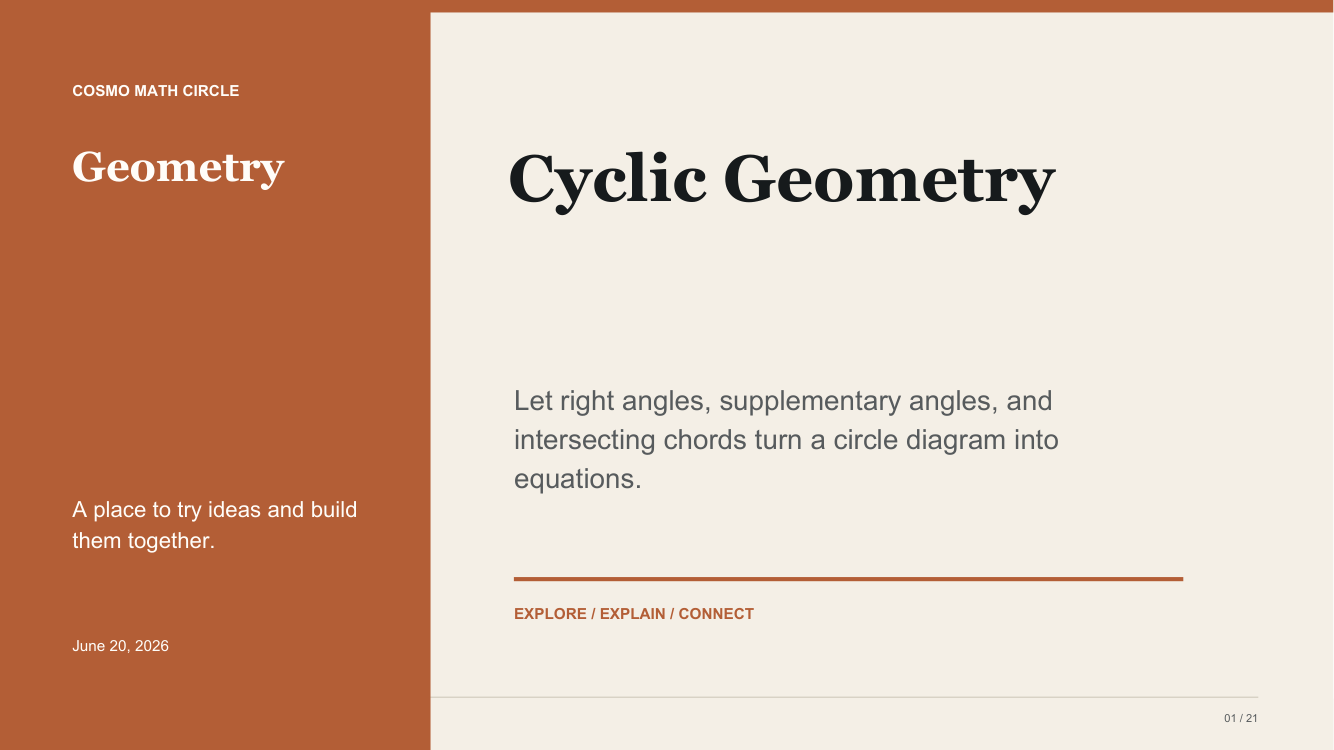
Cyclic Geometry teaching deck cover
Geometry AMC / AIME enrichment 21 slides Published June 20, 2026
GeometryAMCAIMEMathematics

Cyclic Geometry

Let right angles, supplementary angles, and intersecting chords turn a circle diagram into equations.

View teaching arc
  • Mark the circle condition before calculating.
  • Choose an angle or product route deliberately.
  • Check near and far segment labels on secants.
Students work through
  • When does a diameter create a right angle?
  • When do two secants give a product equation?
  • What conditions are needed for intersecting chords?
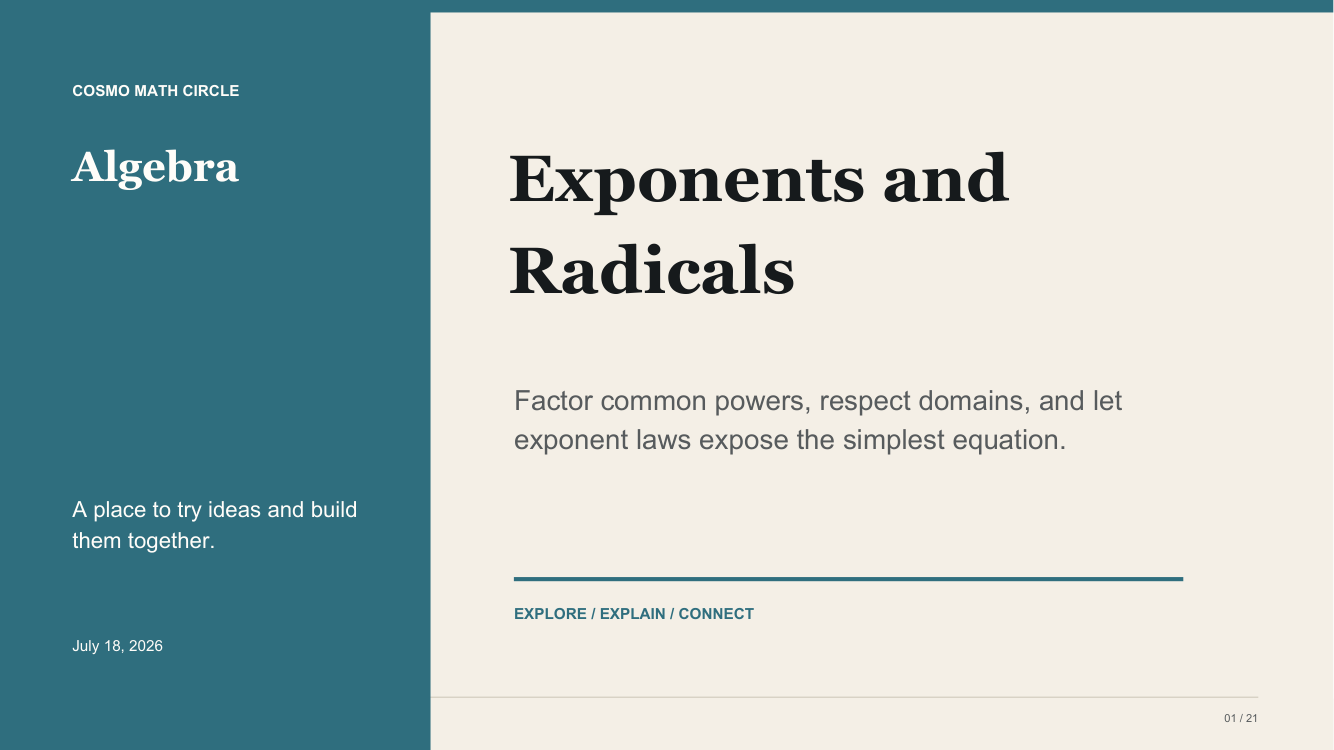
Exponents and Radicals teaching deck cover
Algebra AMC / AIME enrichment 21 slides Published July 18, 2026
AlgebraAMCAIMEMathematics

Exponents and Radicals

Factor common powers, respect domains, and let exponent laws expose the simplest equation.

View teaching arc
  • Rewrite related bases before calculating.
  • Protect the domain before squaring a radical equation.
  • Use exact forms until a final check.
Students work through
  • How do common bases simplify a power equation?
  • What restriction appears before squaring?
  • How can a sum of powers be factored?
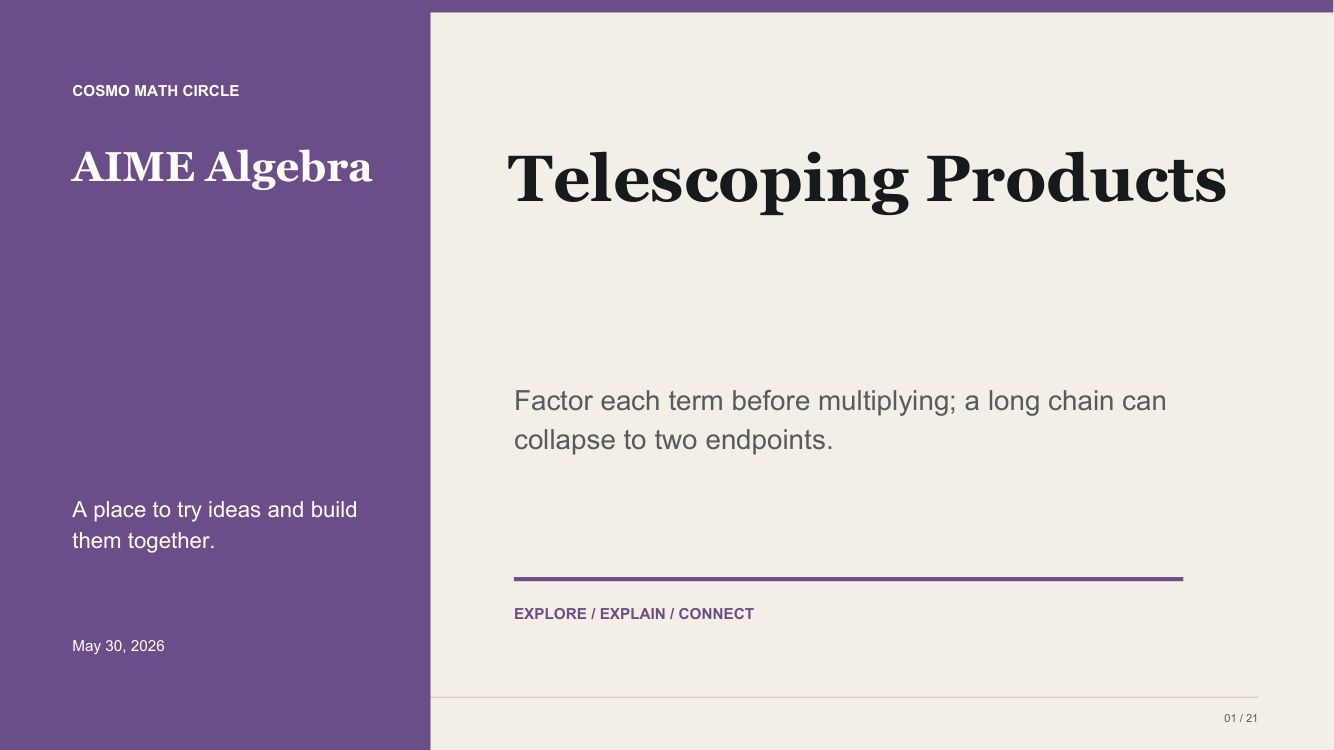
Telescoping Products teaching deck cover
AIME Algebra AIME bridge 21 slides Published May 30, 2026
AlgebraAIMEMathematics

Telescoping Products

Factor each term before multiplying; a long chain can collapse to two endpoints.

View teaching arc
  • Factor terms into neighboring pieces.
  • Cancel only after writing the full product.
  • Check which endpoint factors remain.
Students work through
  • Which factors cancel in a telescoping product?
  • What stays at the two endpoints?
  • How can a product be rewritten to expose cancellation?
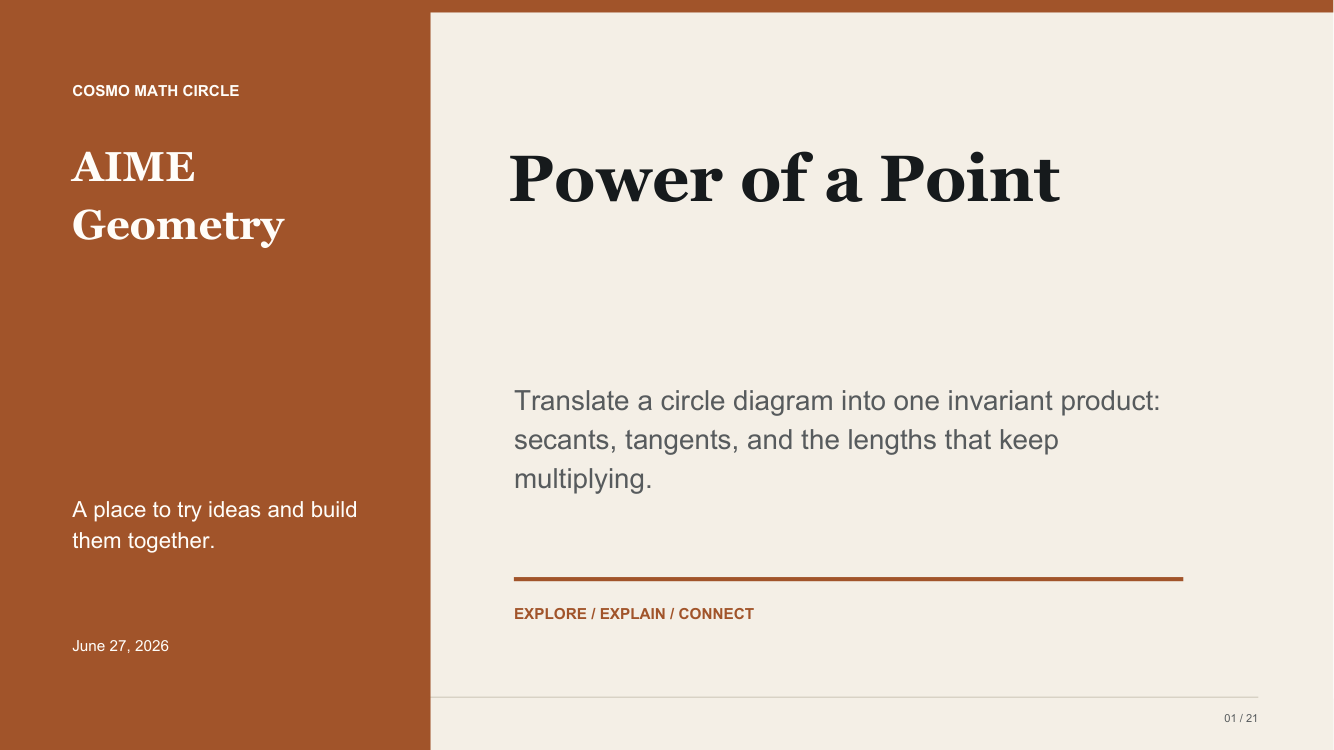
Power of a Point teaching deck cover
AIME Geometry AIME bridge 21 slides Published June 27, 2026
GeometryAIMEMathematics

Power of a Point

Translate a circle diagram into one invariant product: secants, tangents, and the lengths that keep multiplying.

View teaching arc
  • Identify the common point first.
  • Turn secant and tangent data into a product.
  • Use similar triangles to justify the invariant.
Students work through
  • Which lengths multiply from one exterior point?
  • How does a tangent fit the product rule?
  • What similarity proves the intersecting-chords relation?
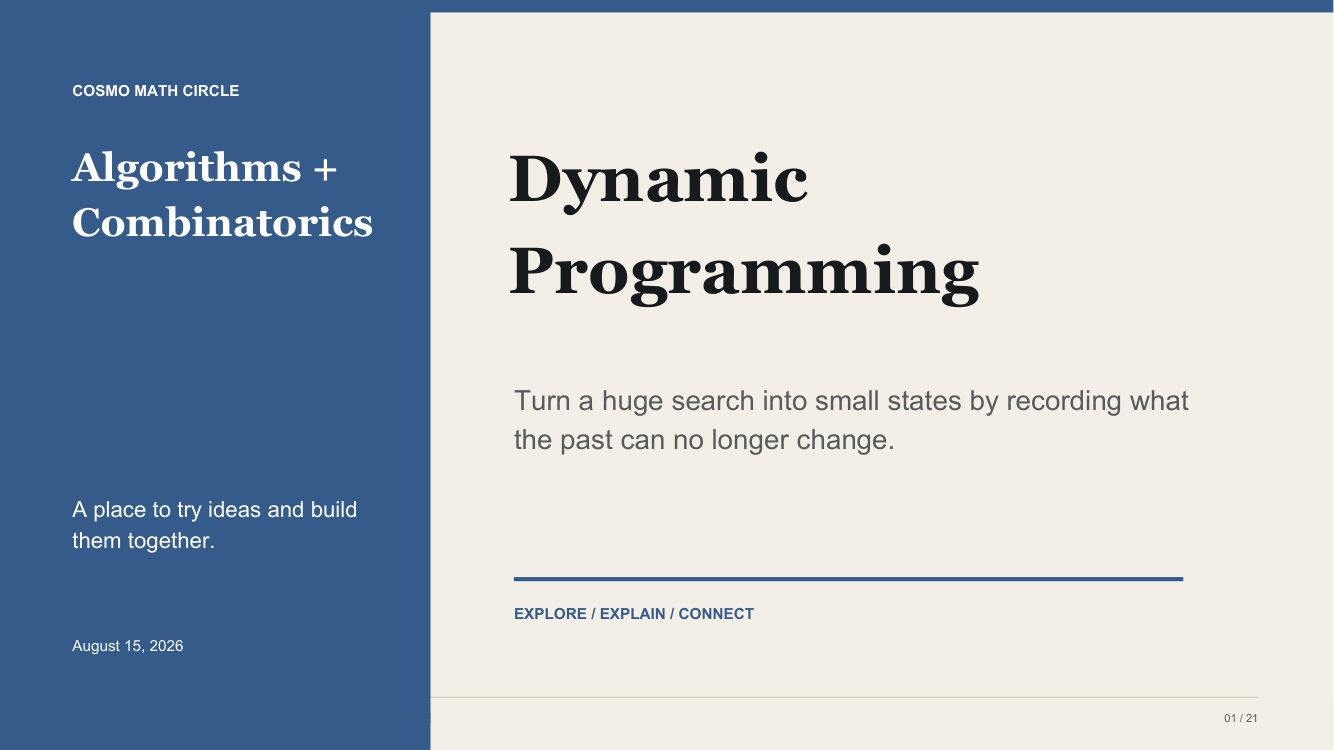
Dynamic Programming teaching deck cover
Algorithms + Combinatorics AIME + CS bridge 21 slides Published August 15, 2026
AlgorithmsComputer ScienceCombinatoricsAIMEMathematics

Dynamic Programming

Turn a huge search into small states by recording what the past can no longer change.

View teaching arc
  • Define a state that remembers only necessary information.
  • Build a recurrence from the final choice.
  • Compare brute force with stored subproblems.
Students work through
  • What information belongs in a state?
  • How can the last move create a recurrence?
  • When does memoization avoid repeated work?