Free biweekly circles · Student-built lessons

A hard problem should feel like an invitation.

COSMO runs free, student-led STEM circles and publishes the exact teaching packets behind them—so students can try, question, and explain before a polished answer arrives.

Mathematics · Computer science · Scientific reasoning

52 complete teaching decks across mathematics and CS
Biweekly Saturday discussion-based STEM circles
Free no fee to join COSMO sessions
— site visits

Curriculum packets

Ready-to-teach decks and practice sets.

Each topic pairs a slide deck with discussion prompts and answer-keyed practice, so a chapter can run the session without building everything from scratch.

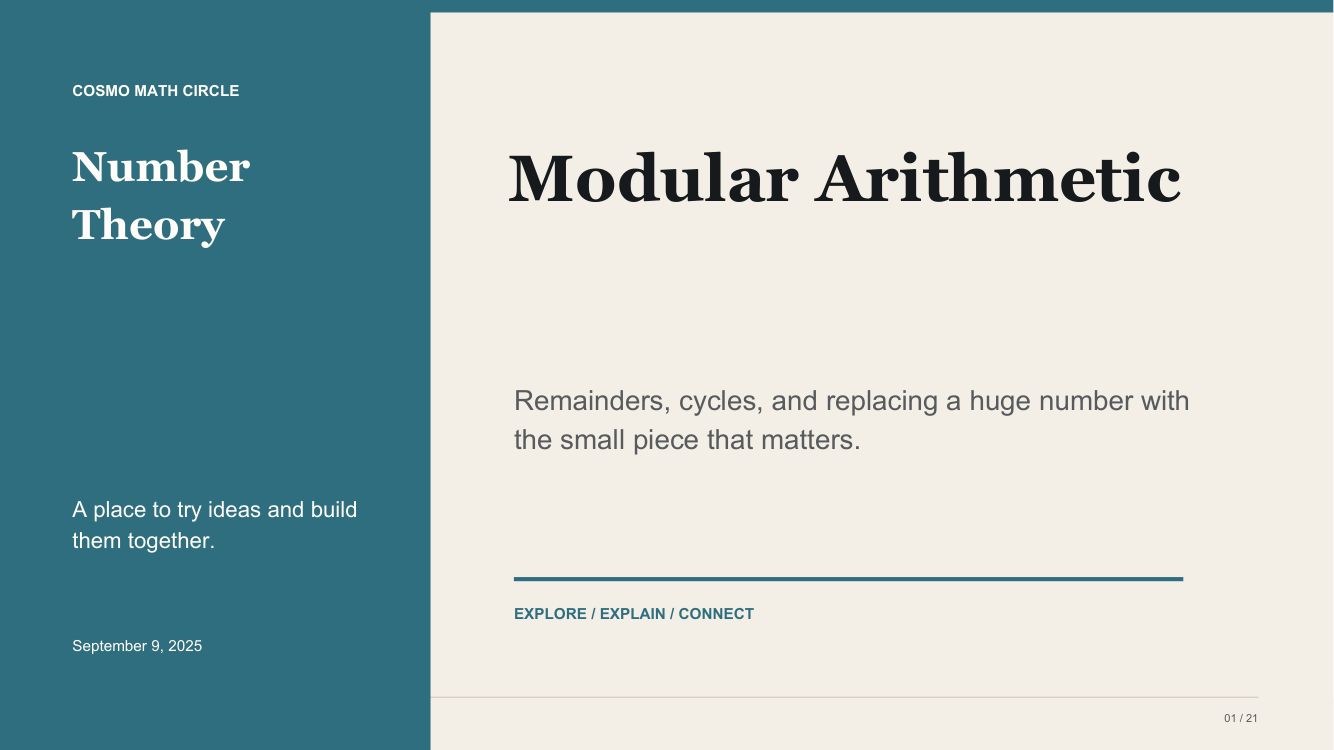
Number Theory 21 slides

Modular Arithmetic

Remainders, cycles, congruences, and why huge-number questions often need only a small repeating pattern.

  • Open with the last digit of 7^2026.
  • Build cycles before introducing congruence notation.
  • Explain divisibility tests through place value.
September 9, 2025 View packet →
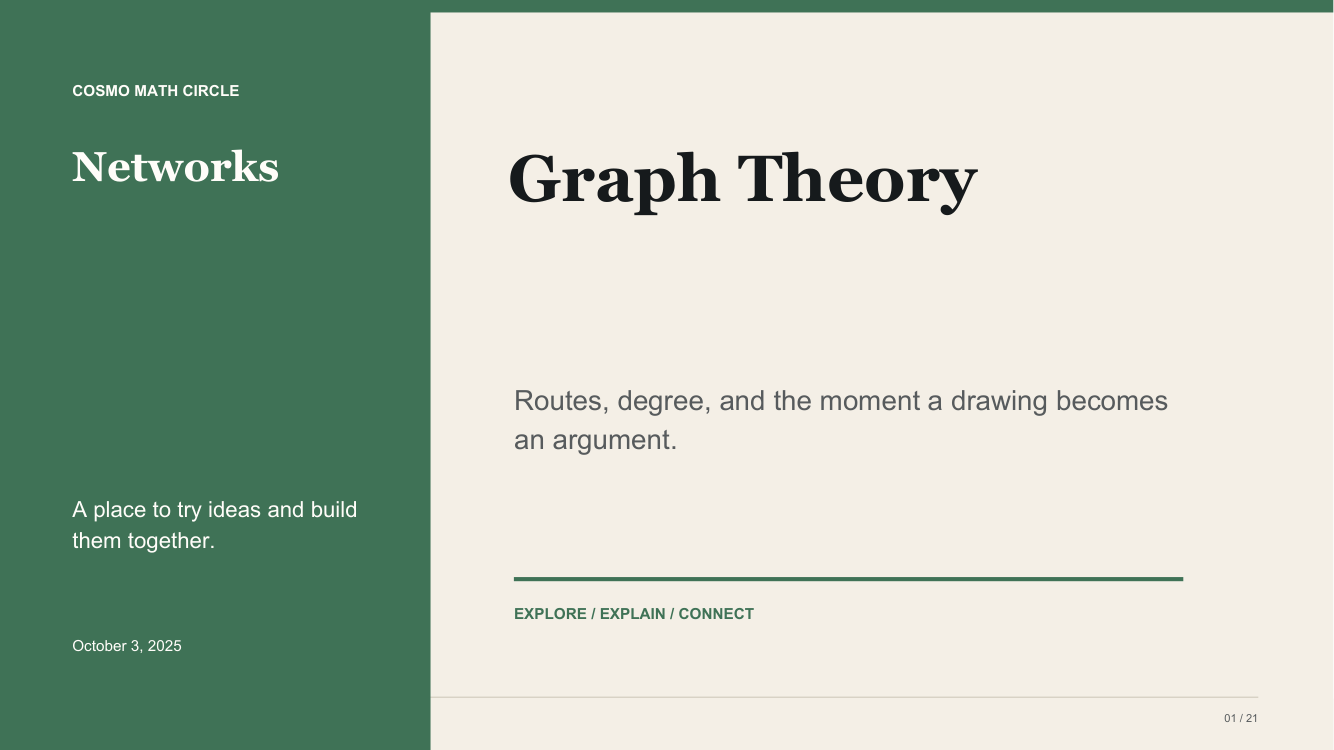
Networks 21 slides

Graph Theory

Vertices, edges, degree, Euler routes, trees, and the local counts that decide global network questions.

  • Begin with a one-stroke tracing puzzle.
  • Build the odd-degree rule from entry and exit pairs.
  • Use the degree sum as a short proof.
October 3, 2025 View packet →
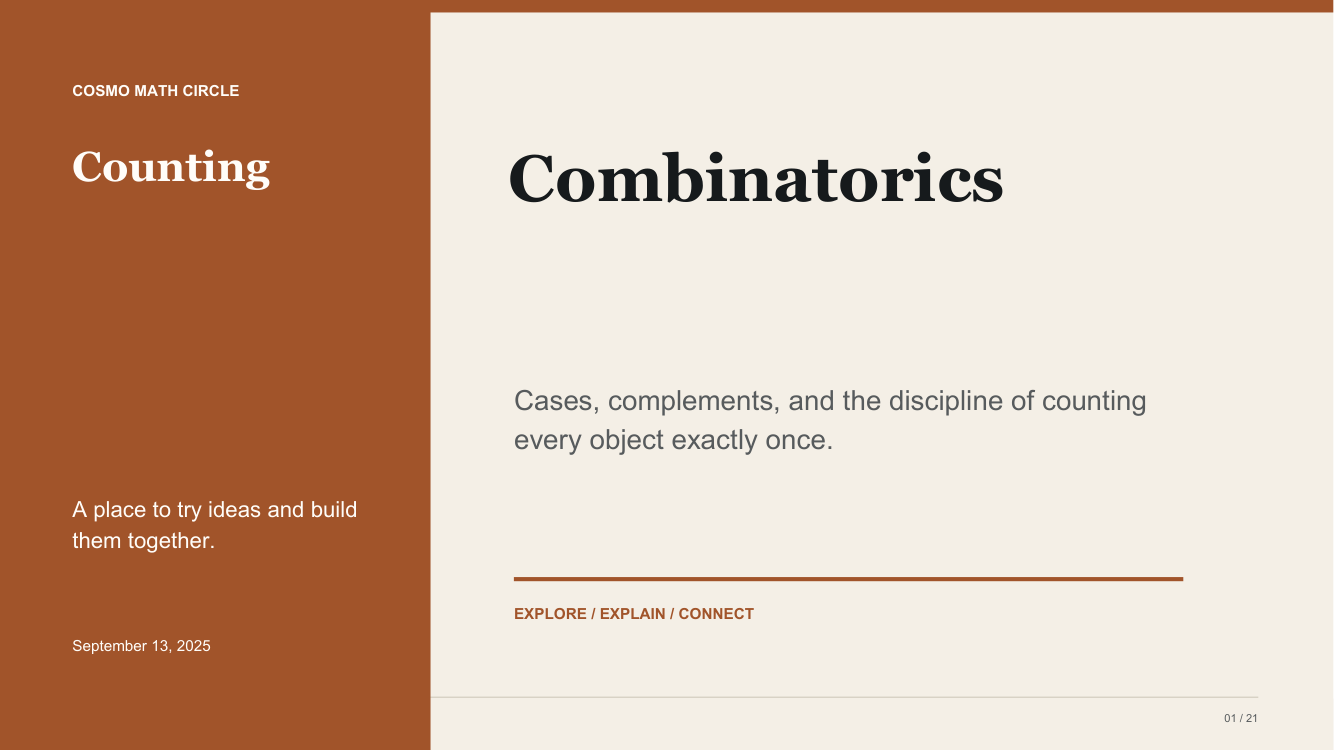
Counting 21 slides

Combinatorics

Cases, complements, bijections, and the bookkeeping habits that prevent hidden overcounting.

  • Defend the division by two in the handshake count.
  • Compare direct and complement methods.
  • Use reversible pairings as proof.
September 13, 2025 View packet →
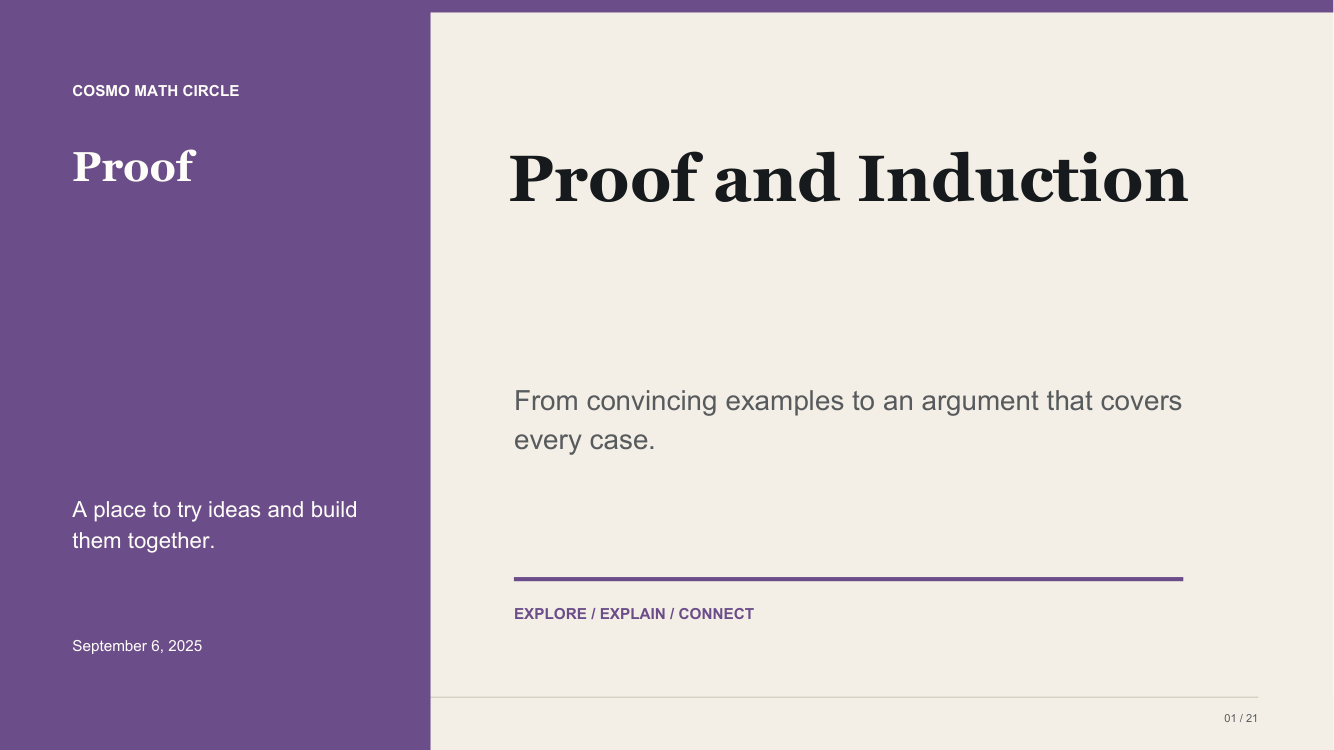
Proof 21 slides

Proof and Induction

Evidence versus proof, the precise role of an inductive hypothesis, and how a chain reaches every case.

  • Grow square numbers from odd-number borders.
  • Label BASE, ASSUME, STEP, and CONCLUDE.
  • Repair a proof whose logical link is missing.
September 6, 2025 View packet →
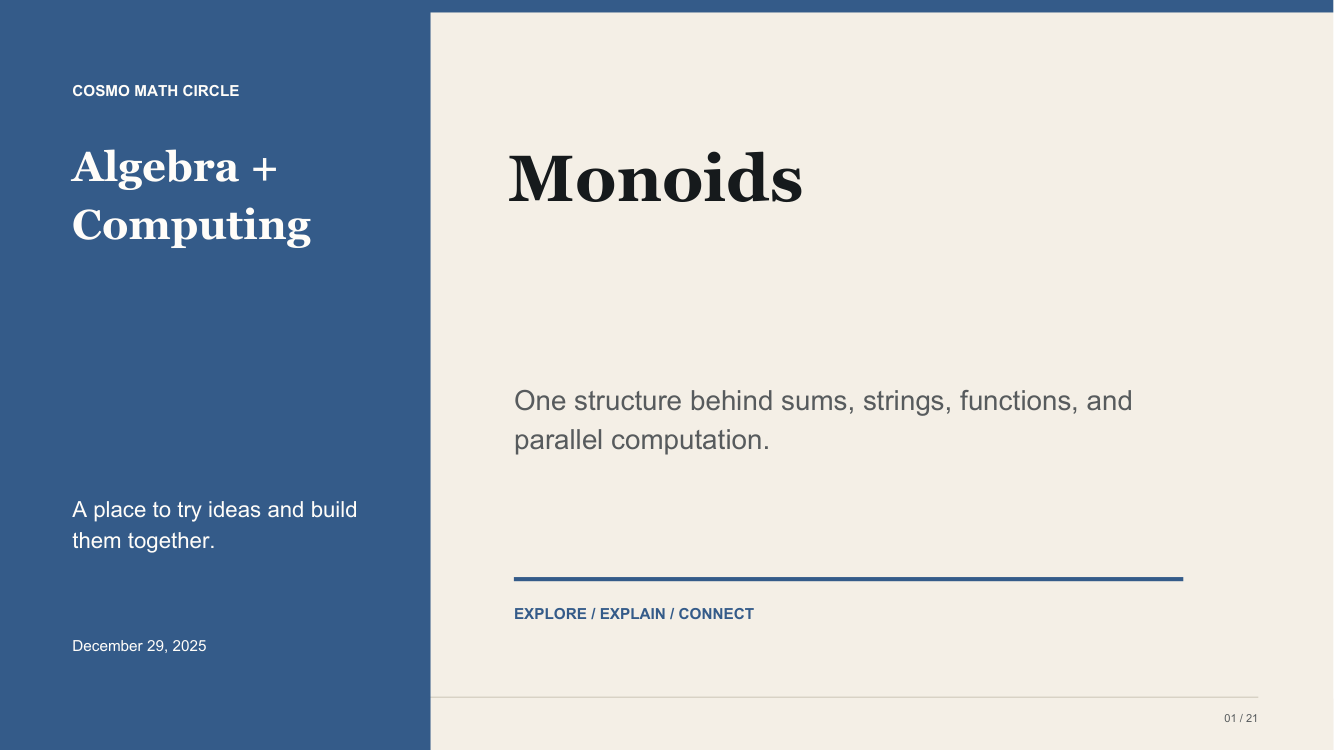
Algebra + Computing 21 slides

Monoids

Closure, associativity, identity, and the structure shared by sums, strings, functions, and data reduction.

  • Sort examples before naming the structure.
  • Test the set and operation together.
  • Connect associativity to chunked computation.
December 29, 2025 View packet →
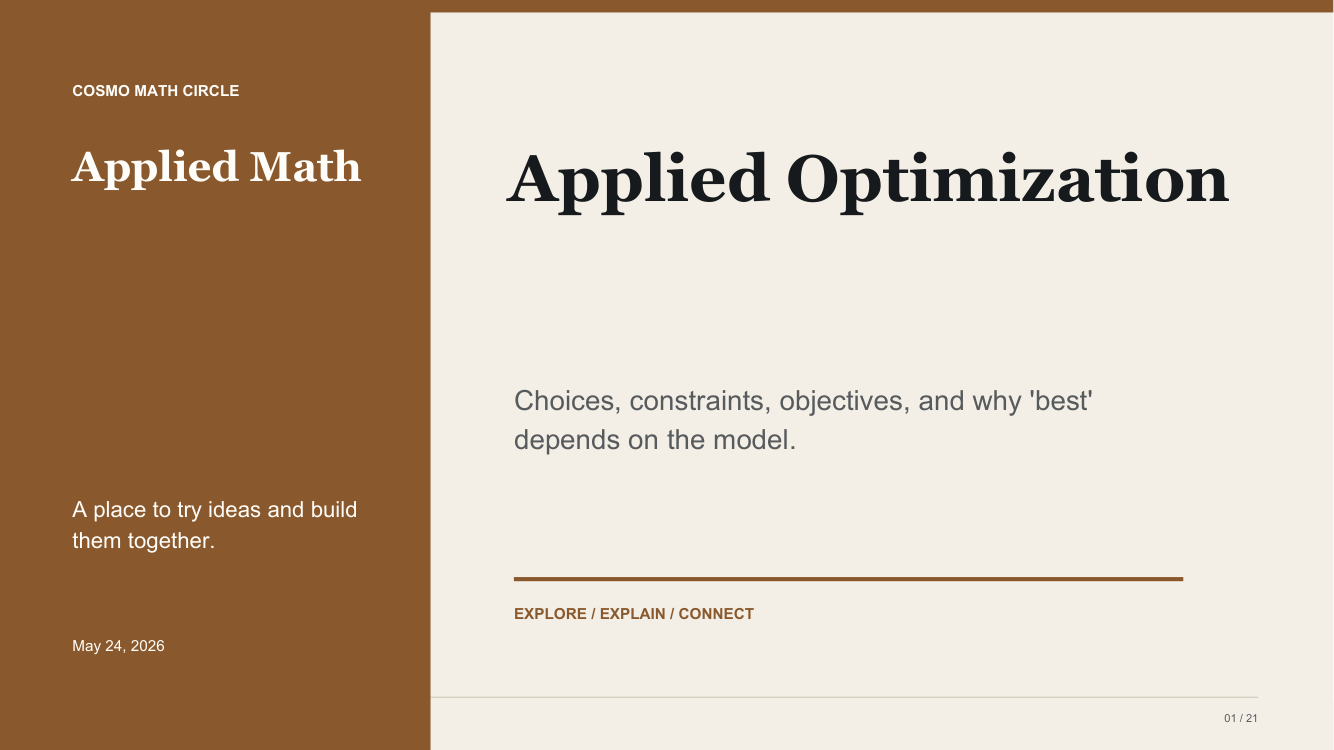
Applied Math 21 slides

Applied Optimization

Decision variables, constraints, objectives, feasible choices, and why a locally good move can fail globally.

  • Ask what 'best' means before calculating.
  • Separate decisions, constraints, and objectives.
  • Disprove a greedy rule with a counterexample.
May 24, 2026 View packet →
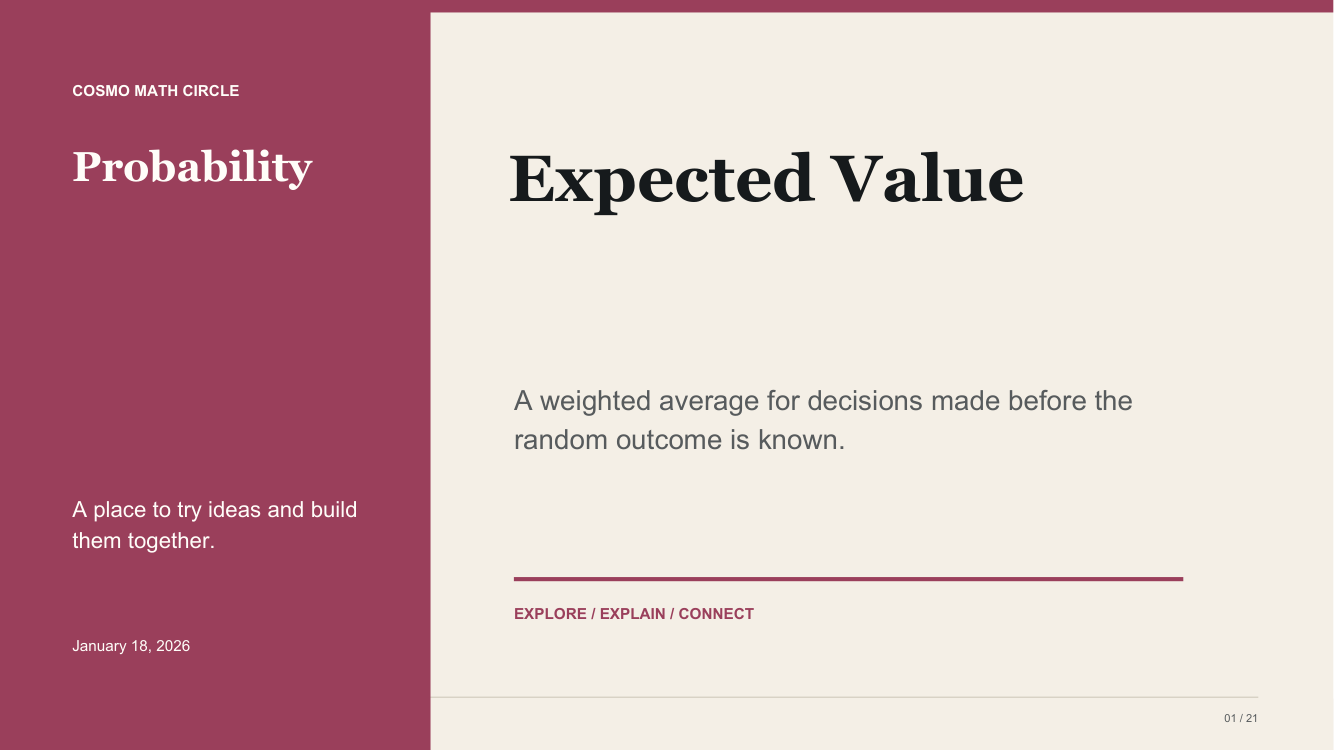
Probability 21 slides

Expected Value

Outcome tables, net payoff, fair games, linearity, and what a long-run average can and cannot predict.

  • Audit a coin game before defining fairness.
  • Keep probability and payoff in the same table.
  • Separate expected value from the most likely result.
January 18, 2026 View packet →
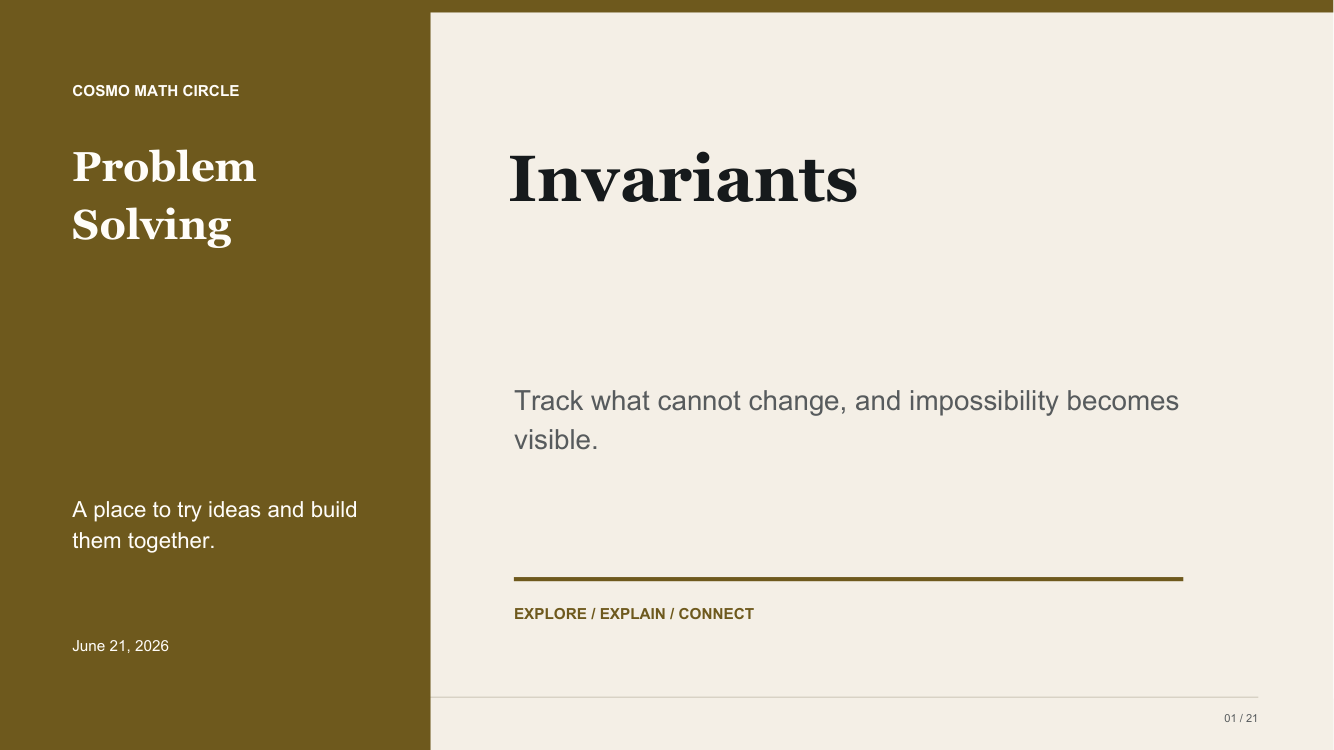
Problem Solving 21 slides

Invariants

Parity, coloring, preserved quantities, and the strategy of proving impossibility without tracing every move.

  • Open with the mutilated chessboard.
  • Track START, MOVE EFFECT, and TARGET.
  • Contrast invariants with decreasing monovariants.
June 21, 2026 View packet →
Browse the complete teaching library

What COSMO is

One circle can hold more than one kind of problem.

COSMO was built to make high-level STEM learning easier to access, especially for FGLI and underrepresented students. Sessions remain discussion-based: students test ideas together before an instructor formalizes the mathematics or computation.

Virtual meetings can use separate Math, CS/AI, and Science breakout rooms, or bring everyone together for one shared topic. The choice depends on the students present and which instructors are leading that session.

Get involved

Join the circle, teach a session, or start another chapter.

Keep the entry point simple. Students can join for free, and instructors can help with live sessions or curriculum.

For students

Join a STEM Circle

Meet every other Saturday for mathematics, CS/AI, science, or a shared interdisciplinary session.

Join This Circle
For instructors

Teach with COSMO

Lead live sessions, develop curriculum, or help with both.

Teach with COSMO
For new communities

Start a Chapter

Bring COSMO's lesson packets and discussion model to your school or community.

Start a Chapter
Teaching move 1

Start with a problem students can enter without already knowing the vocabulary.

Teaching move 2

Let students compare messy attempts before showing a polished solution.

Teaching move 3

Use the formal idea only after it helps explain something they already noticed.

COSMO teaching rule

Do not let vocabulary outrun curiosity.

A lesson should begin with a pattern, route, game, graph, or counting mistake that students can argue about. Definitions matter more when they solve a problem students already care about.

What the materials emphasize

  • Reasoning before formula memorization
  • Concrete models before formal notation
  • Problems that invite multiple approaches
  • Proofs written in language students can defend
  • Applications that admit tradeoffs instead of pretending math is magic

Join a circle

COSMO STEM Circles meet every other Saturday.

Work through challenging problems with other students in your community or online. Depending on attendance and instructor availability, a session may use Math, CS/AI, and Science breakout rooms or focus the whole group on one topic.

Biweekly schedule

Every other Saturday

The next circle session is coming up.

Session time and any session-specific details are shared with the session update.

Join Zoom Session

Upcoming topics

What's coming next

01
Geometry moves: symmetry, transformations, and invariants

· AMC-style geometry begins with what a transformation preserves, then turns those observations into proof.

02
Number theory: modular arithmetic and Chinese remainders

· Use cycles, congruences, and constructive thinking to make huge-number questions manageable.

03
Counting without double-counting

· Build reliable cases, complements, and bijections for AMC and AIME counting problems.

See all past and upcoming study topics
IN PERSON + ONLINE

Dallas Area COSMO Circle

Frisco · Plano · Carrollton

Every-other-Saturday discussion-based sessions for students in the DFW area, available both locally and remotely.

AMC PrepCombinatoricsEmbeddingsAlgorithmsACT ScienceData Reasoning
Join Zoom Session
ONLINE

COSMO Global Circle

Open to students everywhere

Every-other-Saturday online sessions use breakout rooms to keep discussions small and interactive.

ProofsGraph TheoryNeural NetworksSimilaritySAT PrepScientific Models
Join Zoom Session

Join a COSMO Circle

Tell us about yourself

Resource hub

Keep learning between meetings.

Browse instructor-written guides for the mathematics, computing, and science ideas used in COSMO circles.

Neural Networks as Composed Functions

A mathematical view of layers, weights, activations, and why nonlinear functions give neural networks expressive power.

Read More →

July 29, 2026

Distance and Cosine Similarity

How Euclidean distance and cosine similarity compare vectors, when their rankings disagree, and how normalization changes the prob...

Read More →

July 10, 2026